This 5.2% Dividend Is 40% Off (Should You Buy?)

The Contrary Investing Report

Investing and Trading News, with a Contrarian, Sarcastic Twist!

One of the things we contrarian income seekers love about closed-end funds (CEFs) is that they often sell for less than what they’re worth.

CEFs’ discounts are especially appealing these days, as the market levitates into the stratosphere. Because when you buy stocks through a CEF trading at, say, a 10% discount to net asset value (NAV, or the value of the investments in its portfolio), you can get into great companies like Apple (AAPL), Microsoft (MSFT) or Visa (V) for 90 cents on the dollar.

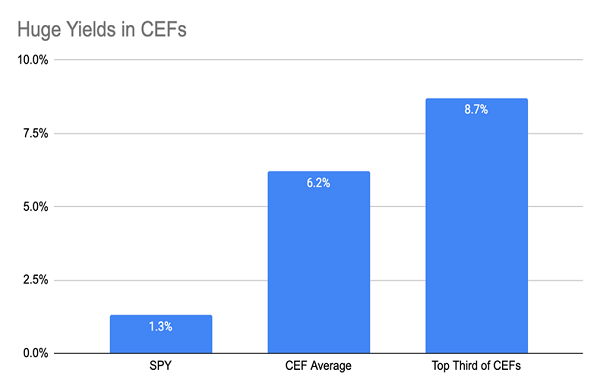
This is a great trick—one you can’t find in ETFs or mutual funds. Plus, CEFs yield 7.3%, on average, today, so you get a monster payout in addition to your discount.… Read more

Read More

If you’re a regular reader, I owe you a big congratulations on the recent profits in your dividend portfolio.

Some of you are banking big yields. Others are riding dividend magnets to capital gains. A select group of savvy contrarians are profiting from payouts and price upside.

The result of your mini windfall, regardless of source, is cash. But this pile of money is not yet generating any income for us. So, what is the best way to employ these greenbacks? We have three options:

  1. Reinvest the dividend money automatically via DRIPs,
  2. Deploy the profits strategically via smart shopping lists, or
  3. Stack the dry powder for a special moment.

Read more

Read More

Let me start with a special shout out to our dedicated readers at Barron’s. Here at Contrarian Outlook, we’ve been drawing up the playbook to retire on dividends for years (Two years ago, we literally wrote the book on the retirement strategy.)

So it was a hoot to see Barron’s run a cover story about retiring on dividends. But I have a bit of constructive criticism about the piece: the dividend stocks highlighted in the feature article had yields too low to actually retire on.

The magazine’s 10 buys included Coca-Cola (KO), International Business Machines (IBM) and Johnson & Johnson (JNJ) and had an average current yield of 4.1% between them (as of the time the piece was written).… Read more

Read More

Let me start with a special shout out to our dedicated readers at Barron’s. Here at Contrarian Outlook, we’ve been drawing up the playbook to retire on dividends for years (Two years ago, we literally wrote the book on the retirement strategy.)

So it was a hoot to see Barron’s run a cover story about retiring on dividends. But I have a bit of constructive criticism about the piece: the dividend stocks highlighted in the feature article had yields too low to actually retire on.

The magazine’s 10 buys included Coca-Cola (KO), International Business Machines (IBM) and Johnson & Johnson (JNJ) and had an average current yield of 4.1% between them (as of the time the piece was written).… Read more

Read More

This mess with Archegos Capital Management has shone a light on the use of leverage in investing. And it’s particularly relevant (in a good way!) to investors in high-yield closed-end funds (CEFs).

That’s because it:

  1. Clearly shows the difference between gambling (what Archegos was doing) and investing in smartly run, value-focused high-yield funds (what we do), and …
  2. Highlights a key misconception about leverage we can take advantage of. (We’ll look at a 5.5%-yielding fund that profits from a methodical use of leverage in a moment.)

Archegos, if you’re not familiar, is a hedge fund that had (until last week) $30 billion in positions in several stocks, including ViacomCBS (VIAC), Discovery Inc.Read more

Read More

It is challenging to find stocks that pay enough money to retire on. For example, even a 3.3% dividend—generous by today’s standards—isn’t enough to turn a $1,000,000 into an income stream that will last forever.

I’ll save you the math. It’s just $33,000 per year on a million dollars.

Fortunately, this same dividend yield is understated on most mainstream financial websites. In reality, this stock paid 7.7% over the past twelve months. Which means its millionaire investors actually earned $77,000 in dividend income.

Yes, you read that right. There was an extra $44,000 hidden in plain sight thanks to a “special” dividend payment.… Read more

Read More

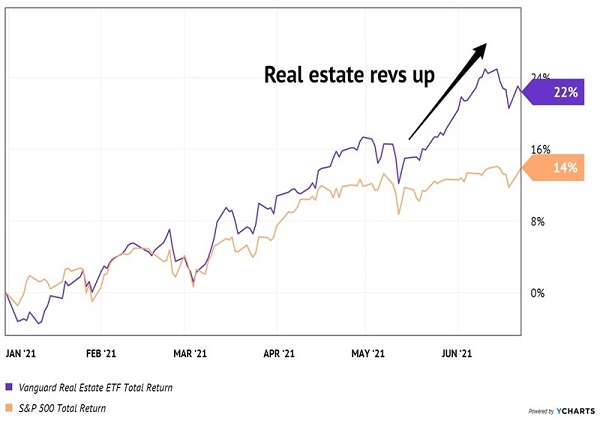
Investors in high-yield real estate investment trusts (REITs) are still living in 2020, and we can tap that for 7% dividends and price upside in the coming weeks.

Let’s start where just about every investment story begins these days: the spring 2020 crash. One thing that stood out during that chaotic time was the relative ease with which workers made the shift to working from home. That gave rise to fears that companies would cut back on office space, an obvious negative for REITs that own office towers.

On the retail side, mall REITs started chasing rent checks from store owners, who were dealing with both COVID restrictions and the accelerated shift to e-commerce.… Read more

Read More

Thank you to our 1,578 Contrarian Income Report subscribers who attended our Q1 webcast a couple of weeks back!

We have you, our thoughtful reader and income investor, to thank for the inspiration behind the firehose. We received 114 questions during our one-hour call, plus several more beforehand. Amazing.

As promised, I have read each and every question (as has our excellent customer service team). Last week, we chatted about CEFs. Let’s tackle some dividend stock questions today.

Q: I love your overall dividend approach. I have some cash on the sideline expecting a correction. Any thoughts on the timing and percentage dip of that correction?Read more

Read More

Stocks are floating higher and interest rates are spiking. The US recovery is still fragile. Even so, people are being vaccinated fast and the global economy is a coiled spring. Should we take advantage of the current pullback to secure more dividend for our dollar now, while we still can?

I’ve got a two-step dividend-growth strategy for you that’s perfectly suited to this tough-to-predict market. It’s handed subscribers to my Hidden Yields dividend-growth advisory a gain that’s doubled that of the market in the past four months—and I’m sure it’ll help you, too.

Step 1: Focus on Dividend Stocks With “Relative Strength”

In a pricey market like this one, it pays to go with dividend-growth stocks showing what I call “relative strength.”… Read more

Read More

There’s an opportunity unfolding for us in one corner of the closed-end fund (CEF) market, and we can tap it for 7.5% dividends and price upside, too.

That opportunity is in CEFs that hold preferred shares. And it includes a CEF called the John Hancock Preferred Income Fund II (HPF), which not only pays a 7.5% dividend but is positioned to grow its payout. So every $100,000 you put into HPF gets you $625 a month in income, versus $119 a month you’d get from the typical S&P 500 stock. And that’s just to start.

If you’re unfamiliar with preferreds, they’re like the common stocks most people buy except they pay higher dividends (preferreds typically pay 4% or more, versus the average sub-2% yield on common stocks).… Read more

Read More

Categories