
981 Risky Bonds to Sell, 400 Safe Ones to Buy Instead (for 7.7%)

The Contrary Investing Report

Investing and Trading News, with a Contrarian, Sarcastic Twist!

Be careful how you buy your bonds. The most popular tickers have a few “fatal flaws” that’ll doom you to underperformance at best, or leave you hanging in the event of a market meltdown at worst!

Let’s pick on the widely followed and owned iShares iBoxx High Yield Corporate Bond ETF (HYG) as an example. It has attracted $15 billion in assets because:

  1. It’s convenient – as easy to buy as a stock.
  2. It’s diversified (for better or worse, as we’ll see shortly) with 981 individual holdings.
  3. It pays–5.6% today, to be specific.

The accessibility of funds like HYG appears cute and comfortable enough.… Read more
Read More

If you’re sitting in “dead money” Treasuries and CDs, the dawn of a new round of interest-rate cuts is probably the last thing you want to hear.

Since Federal Reserve Chair Jerome Powell’s “pivot” on rates in early January, the yield on the 10-year Treasury has plunged, from 2.7% to 2.0%.

So if you put a million bucks in Treasuries at the start of the year, you’d be banking $26,900 in income. That’s pathetic enough for a seven-figure nest egg!

But fast-forward just six months, and your mil fetches you far less: just $20,100.

Powell Will Spark a Stampede Into These 8% Dividends

With Treasury rates collapsing and the stock market soaring—driving S&P 500 dividend yields down to a lame 1.7%—there are few places for income-seekers to turn.… Read more

Read More

Let’s face it: you hardly ever get decent income from commodity stocks. And when you do, these payouts are usually first to get the axe next time, say, oil nosedives.

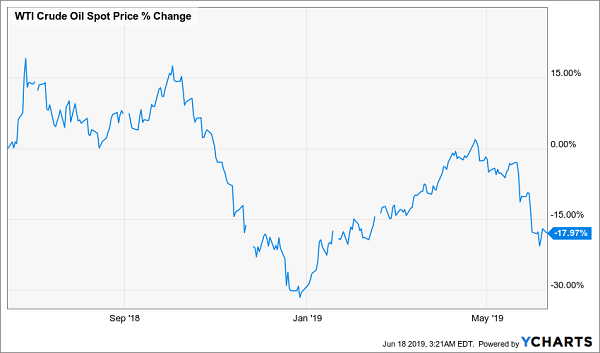
And with oil doing this…

Oil Falls—Oil Companies’ Profits to Follow

… you may worry that it’s about to get harder to squeeze income out of oil companies.

Still, if you’re worried about inflation or the Federal Reserve distorting markets, or if you just want to hedge your stock portfolio, you’ll likely turn to commodities at some point. And there’s no more established inflation hedge than gold.

There’s just one problem: gold doesn’t produce anything.… Read more

Read More

Seven percent dividends.

That’s what my 18 favorite stocks and funds yield on average in my “No Withdrawal” Retirement Portfolio. And it’s that very yield that gives the critically-acclaimed portfolio its name. Investors collect so much income every month that they don’t need to pull out their nest egg to make ends meet.

The regular dividend checks pay the regular bills.

That yield, by the way, was higher just a few months ago, but as prices go up, yields go down … and prices across the portfolio have been going up, up, up!

That’s no happy accident—that’s a vital component to a successful retirement portfolio that many advisors and financial pundits too often miss.… Read more

Read More

Today I’m going to give you a strategy—and a strong 6.5%-yielding fund—that both shine when the market throws a tantrum.

And both are way better than what most people do when things get rough: cash in.

Many studies have shown that trying to time the market simply doesn’t work. And even if you did have the superhuman ability to get in and out perfectly, you’d still underperform a buy-and-hold approach. Thanks to compound interest, keeping skin in the game is more important than trying to save your skin.

Options: Your (Surprising) Friend When Markets Roil

Instead of fruitlessly trying to time the market, we’re going to do something that actually works (and takes far less effort!).… Read more

Read More

Think it’s impossible to bag 852% gains and a 6% dividend in one stock?

It’s not only possible—it’s easy! I’m going to give you the three (and only three) simple steps you need to do it yourself today.

Let’s start with the one thing we’re not going to do: follow the “buy and hope” crowd into a fanboy (and girl) favorite like Netflix (NFLX).

In search of big gains, first-level investors crowd into a non-dividend-payer like Netflix, simply because it’s delivered stunning growth in the past. And they almost always dive in when the stock is at the height of its popularity, like last July, when NFLX was scraping all-time highs.… Read more

Read More

I want to show you 10 funds that yield up to 9.4%—and that you should sell now (or steer clear of if you don’t own them).

Of course, near-10% yields are attractive, and I often see attractive funds yielding as much as (and more than) the 10 funds I’ll reveal in a second. But sometimes a big yield is too good to be true, and that’s the case here.

The reason I’m saying this now? These funds have been on a tear in the last few months, which is far out of character for both them and their asset class.

I’m talking about utilities funds.… Read more

Read More

A three-day holiday may be just what the U.S. stock market needs. Investors turned more defensive in the last week of trading before Summer kicks off on Monday with the Memorial Day holiday.

Traders bought bonds this week, pushing rates lower, while selling stocks. The trade war between China and the U.S. heated up again and investors were spooked by reports of slower growth in Europe. UK Prime Minister Theresa May also said on Friday that she will step down in June, after failing to execute a Brexit strategy in the past three years.

Elsewhere, crude oil posted its worst one-day performance for 2019 on Thursday, though remains 25% higher year-to-date.… Read more

Read More

Mortgage payments. Car payments. Cell-phone bills. Power bills. Water bills. Credit card bills.

What do they all have in common?

Nobody likes them, of course. But more importantly, they all arrive relentlessly month after month.

That’s fine when you have a normal job that pays you every couple of weeks or every month. But that regular bill routine becomes considerably more daunting once you hit retirement, when much of your regular income is coming from your portfolio of dividend paying stocks … which pay out every quarter, not every month.

Investors in turn often build complicated dividend calendars that get knocked out of whack whenever they ever have to cut back on certain stocks.… Read more

Read More

Right now, there are two closed-end funds (CEFs) you need to sell immediately—or steer clear of if you don’t already own them.

Before I reveal them, I want to explain the unmistakable sell signal both are showing as I write this. You can easily use it to “crash-test” the CEFs in your own portfolio, or spot CEF bargains.

A Built-in CEF “Sell Alert”

I’m talking about the difference between the fund’s market price and per-share net asset value, or NAV (which is just another way of saying the value of the CEF’s holdings).

CEFs usually trade at a discount to NAV, and if you’re a subscriber to my CEF Insider service, you know we’ve banked some impressive returns by waiting for those discounts to get ridiculously wide, buying, then holding on as the discount reverts to normal, pushing the share price higher as it does.… Read more

Read More

Categories