
Less Liquidity and More Volatility in ’22: Good for Dividend Stocks?

Our Archive

Search completed

The asset price “fuel” that our Federal Reserve has provided since March 2020 is going away soon. This will likely lead to continued volatility and a challenging backdrop for stocks-at-large.

Periodic “flights to safety” could benefit secure dividend stocks. We’ll touch on the outlook for income plays in a moment. First, let’s talk macro.

The stock market has been rallying for 21 months thanks to the Fed. It has gassed asset prices by buying trillions of dollars in bonds.

(Note: “Bond buying” is a polite way of saying “money printing.” The bonds were using cash that Chairman Jay Powell created out of thin air.)… Read more
Read More

Let’s take the hint from the past couple of weeks—2022 looks choppy. And why wouldn’t it? Our prolific money printer Jay Powell has (finally) admitted that inflation is real (not transitory).

His easy money had been floating the market. Now, with Jay reappointed and looking to assuage his Congressional colleagues about rising prices, he’s about to reverse the flow of money. This will likely reverse the rising tide of the market and expose select stocks.

But we dividend investors needn’t panic. With 2022 turning into a stock picker’s market, this is our time to shine. A fragmented market is just fine for us.… Read more

Read More

I shudder when folks tell me their portfolios can’t give them a decent income stream. Because I know there’s an easy way for them to get safe 8%+ payouts—and everyone misses it.

Let’s be honest. When it comes to investing, most people limit themselves to the blue chip stocks of the S&P 500. The problem? These stocks pay a miserly 1.2% average yield. So you’re getting a measly $1,200 in yearly dividend income for every $100K invested!

No one is retiring on that—unless they have a couple million bucks lying around.

But there is another way. It’s a potent income generator I’ve been specializing in for more than a decade—and sharing with investors through my CEF Insider service.… Read more

Read More

If the past few weeks are any indication of what’s ahead, we’d better buckle up for a volatile 2022.

Which means we should invest in the relative calm provided by monthly dividend stocks before the mainstream crowd starts looking this way. After all, what’s more soothing than thousands of dividend dollars paid every single month?

Monthly dividends are great because they line up with our expenses. Most blue-chip income stocks pay quarterly—not enough! These “lumpy” payouts result in equally lumpy retirement income. For instance, we might have a big January, but that’s followed by an OK February and a lean March where that check alone wouldn’t come close to covering the bills.… Read more

Read More

Investors sometimes tell me that closed-end funds (CEFs) are complicated—riddled with jargon-y terms like discounts to NAV and net investment income (NII).

The truth is, while it may take a little bit of time to learn the ropes, the effort pays off in spades, since CEFs can get you about $3,000 per month in dividend income on a $500K investment! That could mean retiring a decade or more before folks who rely on low-yielding S&P 500 stocks or ETFs.

(And of course, if you’re a member of my CEF Insider service, I do the legwork for you, letting you collect our portfolio’s 7.3% average yield, with upside, without having to spend hours in front of a computer screen.)… Read more

Read More

A recent research paper from Morningstar concludes that retirees should only withdraw 3.3% of their money annually. In other words, a million-dollar portfolio should only be relied on for $33,000 in annual income.

That is a sad ending for a seven-figure nest egg!

Scary, too. This $33,000 salary isn’t delivered in cash flow. No, this is a “withdrawal rate”—which means the retiree is tapping principal. Which means the retiree is buying stocks and hoping they’ll go up.

But “hope” is not a strategy. The volatile weeks we’ve seen recently have no doubt forced some terrified retirement investors into selling low.

This is “reverse dollar cost” averaging, unfortunately.… Read more

Read More

Jay Powell is finally making noises about kicking his money-printing habit, and we’re going to set ourselves up to profit with an overlooked dividend payer primed to surge in ’22.

(This company isn’t sexy, which is why the herd has ignored it, but it makes a product every food or drink maker must have—and its dividend has tripled in the last five years!)

A couple weeks ago, we talked about investing legend Martin Zweig’s landmark book Winning on Wall Street. In it, Zweig devotes 40 pages to teaching readers why they should “go with the flow” with respect to the Fed’s trend at any given moment.… Read more

Read More

Inflation is up, stocks are soaring (Omicron be damned!) and bargains are thin on the ground.

Well, not all stocks are soaring—one sector has fallen behind, and it’s set us up for some nice “snap back” upside in 2022, with big dividends (yielding up to 7.6%!) on the side. We’ll talk tickers in a moment. First, let’s take a 50,000-foot view of the sector we’re going to dive into and work our way down from there.

That would be real estate, specifically publicly traded real estate investment trusts (REITs), which have been left in the dust in the pandemic- (and Federal Reserve–) powered market of 2020/2021.… Read more

Read More

Why is logging into a 401(K) such a hassle? It’s a circus when we try to log into my wife’s retirement plan. (Any task that starts with “logging into her company’s VPN” is off to a rough start.)

Most people I know don’t even bother checking these accounts. Which is probably good (and perhaps a big unintentional benefit of this user unfriendliness!). It is tough to beat the “set it and forget it” rhythm of regular retirement contributions, where dollar cost averaging works in our favor.

That’s what I did with my last 401(K). I set it once and forgot about it.… Read more

Read More

The Omicron variant is here—what does it mean for us dividend investors?

Simple—we’ll simply do the same thing we did the last time COVID spooked markets: buy tech-focused closed-end funds (CEFs) with huge payouts!

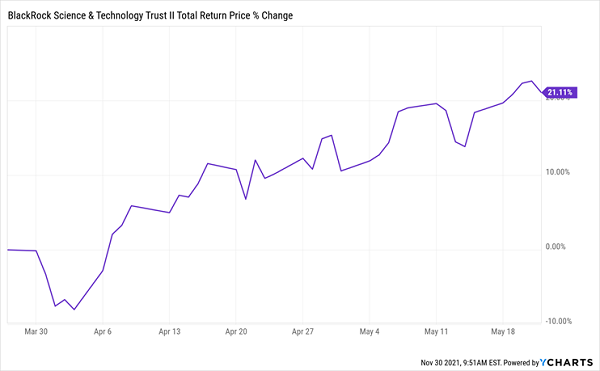
Members of my CEF Insider service will remember that we did just that in March 2020, at the trough of the market’s initial pandemic plunge, buying the BlackRock Science & Technology Trust II (BSTZ) when it yielded 7.3% and traded at a 6.6% discount to NAV. We then rode it to a nice 21% total return in just two months!

BSTZ Gave Us a Nice Profit in the First COVID Panic

Our first hint that tech is the right thing to buy now is came in last Friday’s chaos, in which all countries saw their markets dip, but interestingly only the tech-focused NASDAQ 100 (QQQ) fell less than 2%

That’s telling, because if governments around the world institute new shutdowns, the last sector to suffer will be tech.… Read more

Read More

Categories