
Boaz Weinstein is a name many CEF investors know. He’s an activist investor who’s targeted CEFs in the past, particularly those he sees as underperforming.
Now, another closed-end fund (CEF) investor is adopting Weinstein’s tactics—and turning them on two of the activist’s own funds. This investor’s goal? Wipe out the discounts to net asset value (NAV, or the value of their underlying portfolios) on these two funds, and in doing so drive their prices higher.
It’s a fascinating story, and one that shows how, in the small world of CEFs, skilled activists sometimes turn their attention to each other.
Let’s back up for a moment.
In case you’ve missed it, Weinstein’s firm, Saba Capital Management, has been in the news because, as I wrote a week ago, they’ve taken a break from CEFs to target private-credit funds. And as we discussed in that article, the criticism of private credit lately has been highlighting the value of our CEFs as a source of high, stable dividends.
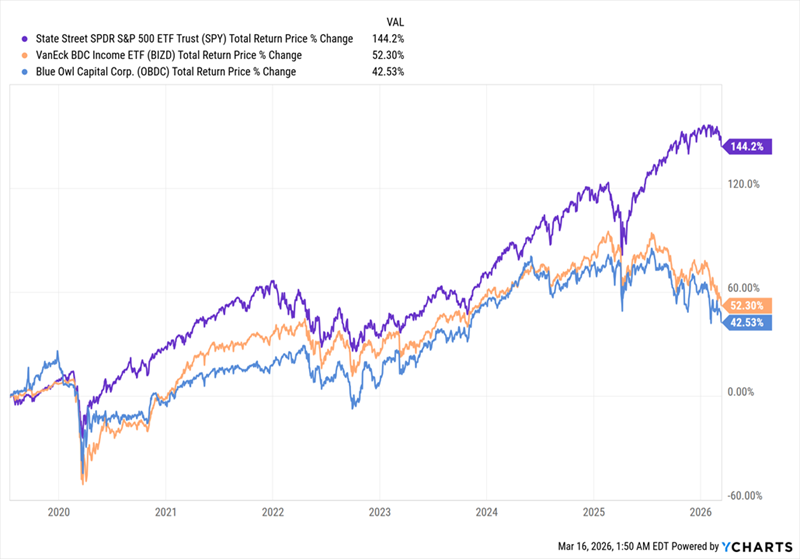
Weinstein has rightly been pointing out that private-credit funds are underdelivering and a source of rising risk. His target has been a cluster of funds managed by Blue Owl Capital, which also runs Blue Owl Capital Corporation (OBDC), a business development company (BDC) that leans toward private credit.
If we compare Blue Owl’s performance (in blue below) with index funds tracking the S&P 500 (in purple) and the BDC market—in the form of the VanEck BDC Income ETF (BIZD), in orange—you can see what Weinstein means:
Blue Owl Lags BDCs, Stocks
Saba’s Approach
The strategy Saba is taking toward these funds fits the culture I’ve observed from talking to people who work for the firm: adversarial, tough and results-driven. But it’s also worth noting that Saba’s own funds have underperformed, opening the door for other investors to take aim at them.
Saba manages two CEFs, both of which trade at discounts far bigger than the 7.7% average discount among all CEFs tracked by my CEF Insider service. Let’s start with the 15.7%-yielding Saba Capital Income & Opportunities Fund (BRW), in blue below:
BRW Falls Behind …
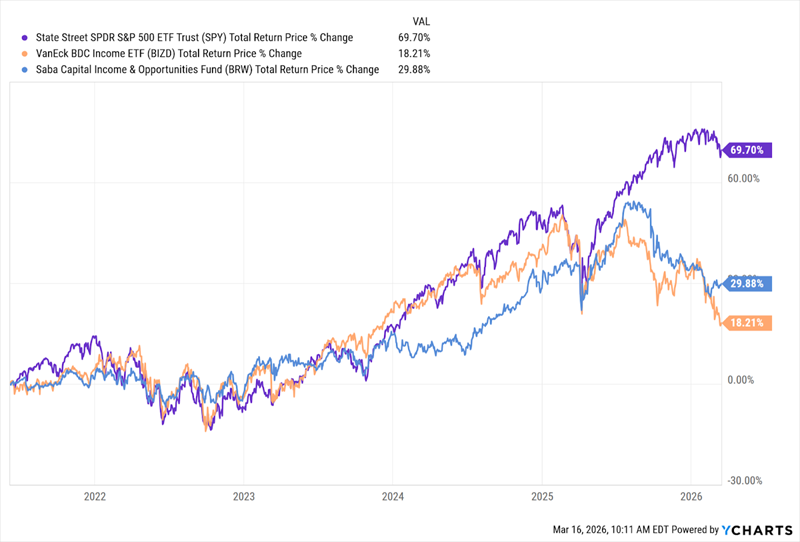
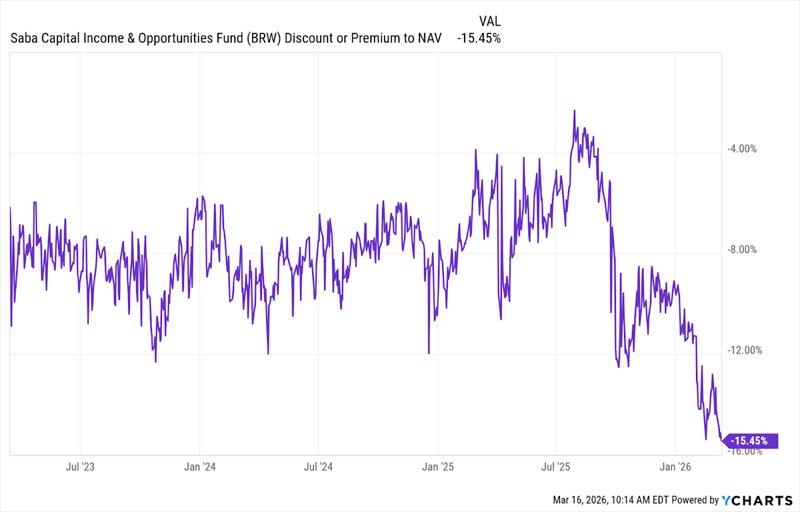
Here we see that, since Saba took over BRW, the fund (in blue) has outperformed the BDC benchmark VanEck BDC Income ETF (BIZD), in orange. But it’s still delivered less than half of the S&P 500’s return (in purple). This is why BRW trades at a 15.5% discount as of this writing, and that discount has been widening.
… And Its Discount Gets Wider
It’s a similar story at the 8.6%-yielding Saba Capital Income & Opportunities Fund II (SABA):
SABA Also Lags …
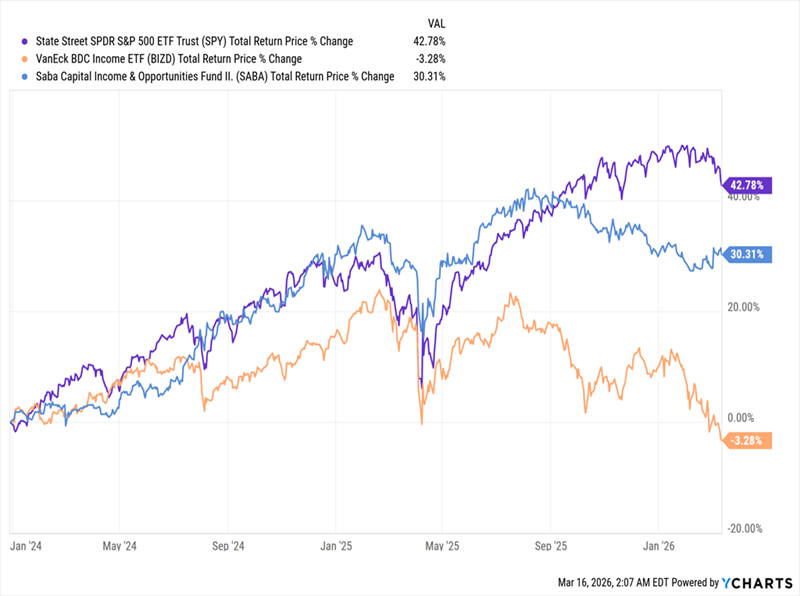
For a while, SABA (in blue above) was outrunning the S&P 500, but its aggressive investments in crypto (Grayscale Ethereum Classic Trust is its second-largest holding as of this writing) mean its short-term gains have been fizzling lately.
We should also note that about 20% of SABA was in private funds as of the end of October 2025, and the fund warns shareholders that they may be at risk of owning private credit if they own SABA.
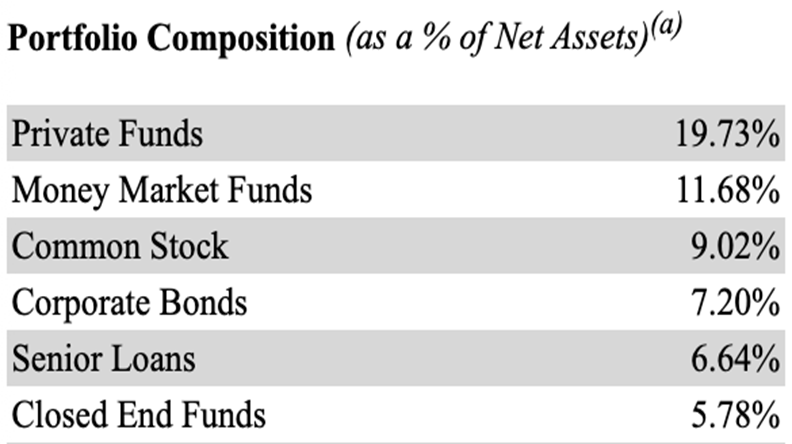
Source: SEC
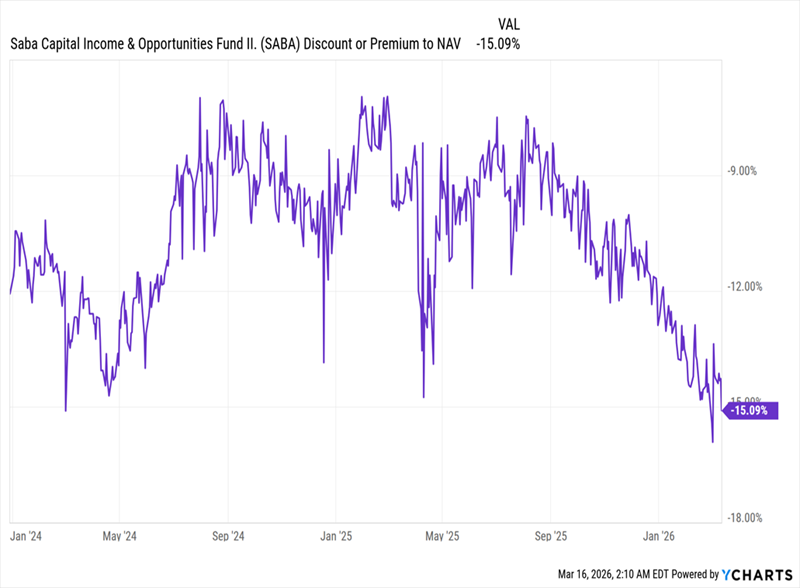
That partly explains why SABA’s discount has also widened in recent months:
… and Sees Its Discount Drop
To be fair, comparing either of these funds to the S&P 500 and BIZD is a little “apples to oranges,” but for investors looking for returns and dividends, that may not matter.
The Gabelli Response
Here’s where our “other” activist comes in.
That would be GAMCO Investors, run by well-known value investor Mario Gabelli. GAMCO is what I’d call a more traditional CEF firm, and it’s spotted an opportunity to target Saba’s funds in a similar way that Saba has targeted CEFs in the past.
And one of Gabelli’s funds stands out now, for the opposite reason as SABA and BRW do: This one trades at a massive premium to NAV:
Gabelli Utility Fund Trades for Nearly 2X Its Portfolio Value
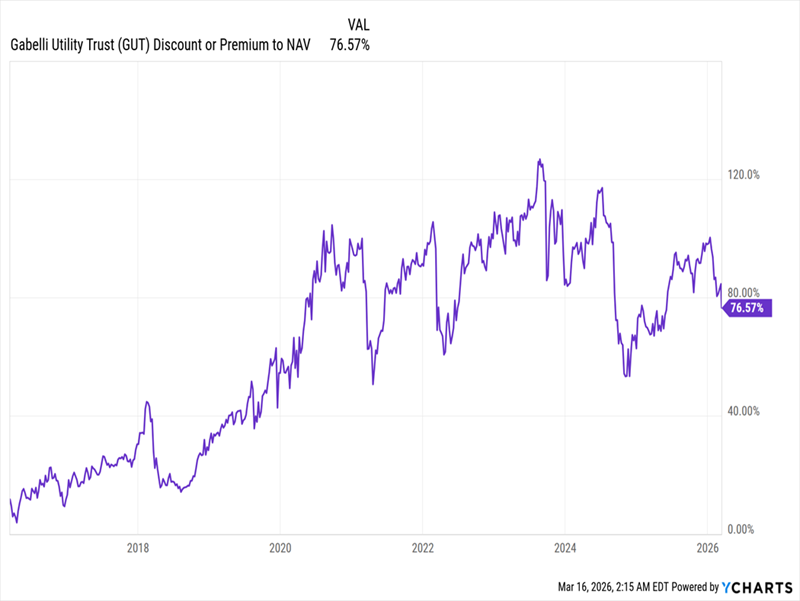
Here we see the 77% premium on the Gabelli Utility Trust (GUT). The fund, which holds major US utility stocks like NextEra Energy (NEE), Duke Energy (DUK) and ONEOK (OKE), has surged to that big premium in recent years.
That’s great for anyone who bought in back in the mid-2010s, when GUT traded at much smaller premiums (in the 7% to 10% range), as they can now sell at this premium.
In short, GAMCO has done for GUT what Saba aims to do for other funds: boost their valuations, thereby delivering strong returns for investors.
GAMCO aims to do this for SABA and BRW by nominating David Schachter, vice-president of GUT, to the boards of both funds. In other words, Gabelli is taking a page out of Saba’s activist playbook to influence the performance of Saba’s own CEFs.
Will it work? Tough to say, but it’s not impossible, especially if Schachter brings Gabelli’s value-investing approach to Saba (which could, among other things, curtail some of Saba’s crypto and private-credit investments).
That, of course, would be good for shareholders in the long term (again, if Schachter’s appointment comes to pass). But now is not the time to pounce in hopes that this happens, since it’s still a long time until this story plays out. No matter what transpires, at least between now and the time the nomination is decided, both BRW and SABA continue to entail above-average risk.
My 5 Top Monthly Dividend CEFs Pay Out 60 Times a Year (and Yield 9.3%, Too)
It’s worth restating: BRW and SABA could be smart buys in the coming months. But they’re simply too volatile for us to touch now.
And while the CEF world is small, it’s not that small.
There are still plenty of CEFs out there paying big dividends and sporting wide discounts. And plenty go one step further and pay dividends monthly, too.
I’ve assembled 5 CEFs that meet both those benchmarks and kick out a rich 9.3% average dividend between them. Think about that for a moment: Own all 5 of these monthly payers and you’re getting paid around 5 times a month.
That’s a total of 60 dividend payouts a year!
I’ve put all 5 of these reliable monthly payers together in a “mini-portfolio” all their own. I’m urging income investors to buy all 5 of them now.
Now is the time to buy them and start your 60 “paycheck” income stream. Click here and I’ll tell you more about these 5 stout monthly income plays. I’ll also give you a free report revealing their names, tickers and my full analysis of each one.
Recent Comments