
We need to talk about this bitcoin plunge.
I know. We’re income investors, so you may be wondering why we need to talk about crypto at all, right?
Two reasons.
First, there are bitcoin-driven income ETFs out there. And I’m concerned this latest drop might convince some people that these funds are a good value now. (Hint: They’re not.)
Second, I’m concerned the cryptocurrency’s latest drop might ward investors off of income-focused closed-end funds (CEFs) that focus on the technology sector as a whole. That would be a mistake. The truth is, bitcoin’s struggles have given us an opening on these high-yield funds.
And if crypto’s faceplant gets worse, I expect that opportunity (including on a 4.6% payer we’ll talk about in a moment) to get even better.
Let’s take these two points one at a time.
First up, it’s worth pausing and appreciating just how far bitcoin has fallen since peaking in early October.
Bitcoin Drops in Half
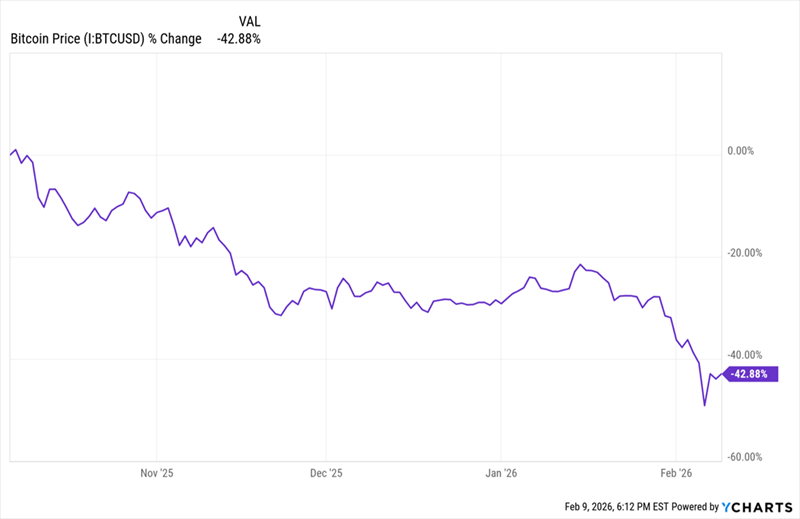
That’s an incredible swoon. And, of course, all the major bitcoin ETFs are down big, too. Those include “dividend” bitcoin ETFs like the NEOS Bitcoin High Income ETF (BTCI).
The fund is the largest income-focused crypto ETF, with over $1 billion in assets. That makes it worth stopping and discussing for a moment, to get a clear-eyed look at the hazards at play here.
Now, we need look no further than BTCI’s web page to see that the “High Income” in its name is no sign of safety—or reliable dividends. The biggest red flag: It lists a yield of 28% as I write this. That’s largely due to the fund’s price drop (as yields and prices move in opposite directions).
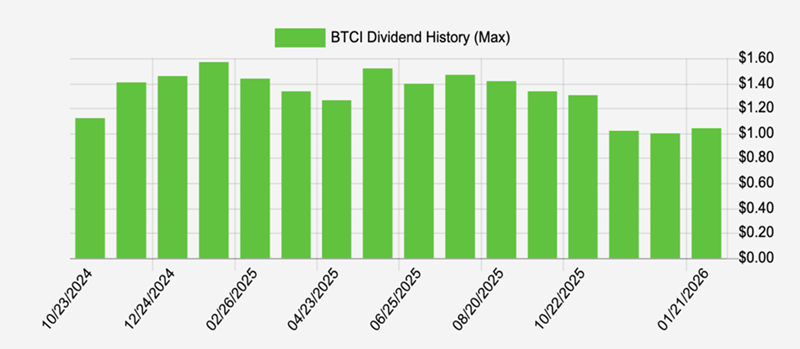
Moreover, the payout has fluctuated in the fund’s short life (BTCI was launched in October 2024):
BTCI’s Unsteady Payout
Source: Income Calendar
BTCI uses a covered-call/option strategy on bitcoin exposure to generate those distributions. That, in theory, should translate crypto gains into reliable income, especially as strategies like these tend to do well in volatile markets. But as you can see above, that hasn’t really been the case.
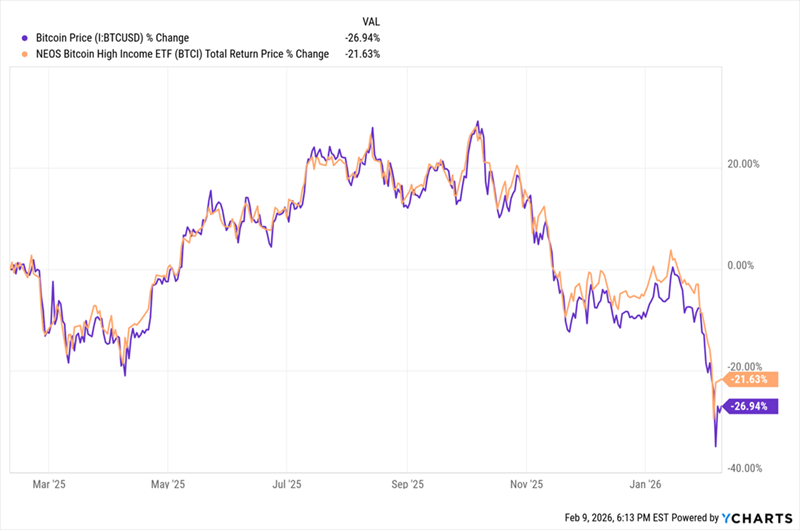
Moreover, BTCI’s income has been little help for generating stability, as the fund (in orange below) has fallen nearly as much as bitcoin itself over the past year, even with distributions reinvested.
Income Fails to Cushion BTCI’s Fall
This poor showing doesn’t surprise me. I’ve seen similar results from similar types of investments over the years. But here’s something I have not seen: The same kind of drop from assets—and here I mean high-yield CEFs—that aim to turn big gains from the technology sector as a whole into income.
That makes sense: Unlike bitcoin, the tech sector in general generates strong cash flows and earnings. Those, in turn, have translated into price gains that have beaten the rest of the market for some years now.
To see what I mean here, consider the Columbia Seligman Premium Technology Growth Fund (STK). It’s a smartly run tech CEF that holds well-known blue chips like Alphabet (GOOGL), Western Digital (WDC) and Apple (AAPL).
The 4.6%-yielding fund is a holding in the portfolio of our CEF Insider service. The difference in performance between it (in orange below) and BTCI (in purple) since BTCI’s launch couldn’t be starker:
STK Dusts BTCI
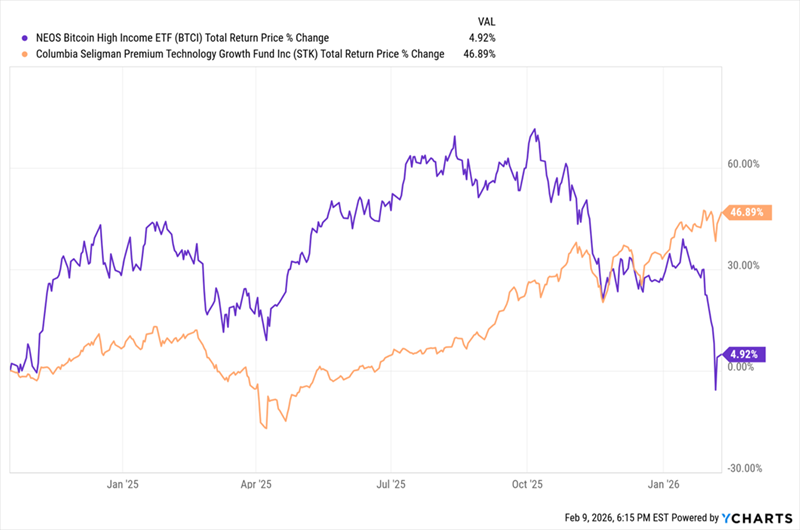
An investor who had the idea to turn tech into income and chose STK would have gained 47%, while BTCI has generated a mere 5% return.
So even after BTCI’s dividends are paid, an investor who was there since the IPO isn’t even really beating inflation and has been on a wild ride, indeed, at one point up well north of 60% before this latest drop began.
The STK investor, meanwhile, has a smaller yield, yes, but they’ve trod a much steadier path to that nice 47% total return. The fund’s payout has been much smoother, too, and has included the odd special dividend:
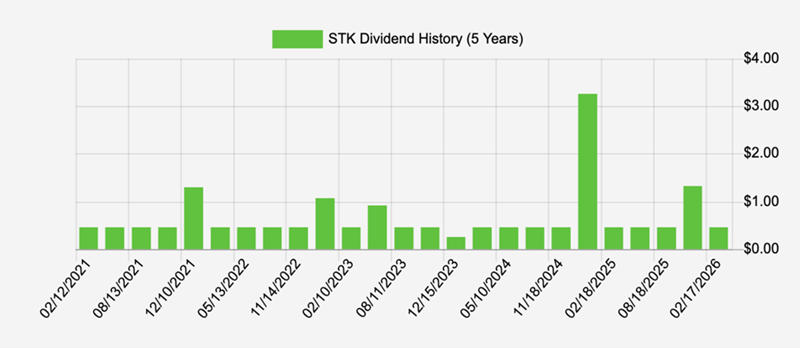
Source: Income Calendar
Finally, thanks to the current “crypto winter,” STK’s discount to net asset value (NAV) has widened to around 4.9%. So we’re essentially getting a 5%-off deal on its high-quality holdings on a buy made as I write this.
That’s the kind of disconnect we contrarian income investors love—one where the crowd misreads a problem in one unrelated (and in this case highly speculative) corner of a sector and dumps the whole thing. We’re always happy to take the other side of an argument like that.
4 Urgent “Crypto Winter” Buys Yielding 9%+ (at Big Discounts, Too)
Which brings me to AI. Because, yes, crypto’s crash has given us better valuations on some top AI stocks, too.
We’re buying—but only through a careful selection of bargain-priced, high-yield CEFs.
I’ve hand-picked 4 for you. They pay much higher dividends than STK (I’m talking a 9% average payout between the four of them). That makes this quartet perfect for you if you’re on the hunt for high income now.
And, like STK, these four funds are seeing wider discounts, thanks in part to this “crypto winter.”
The key to these funds’ appeal is that they’re balanced between providers of AI applications and users of this tech—think manufacturers, finance stocks and healthcare names. That’s critical because AI users will likely see the biggest gains as this tech boosts their efficiency and helps them tap into new sources of growth.
We’re snapping up these 9% dividends for cheap now. I want you to join us and start profiting (and collecting high income) as we do.
Recent Comments