
Is your portfolio on track to yield 26% in 2026?
If not, why not?
Of course, most stocks and funds don’t pay 26% on their own. But it’s a quick fix to get many of them to.
This makes a big difference to our retirement goals: a 26% return on a million-dollar portfolio is $260,000 in cash flow per year! Without tapping the principal.
Or $130,000 in cash flow on $500K. You get the idea. With 26% coming in, it’s a lot easier to retire.
How can we boost our investment income like this? Let’s take boring ol’ SPY—SPDR S&P 500 ETF Trust (SPY)—as our first example. The fund yields a sleepy 1.1%, yet it’s the most owned ticker in America.
Here’s how to take SPY’s picayune yield above 26%.
We’ll use OptionSignals, the timing system I developed for Contrarian Outlook readers who write covered calls and sell puts to generate income. OptionSignals tells us when it is a promising time to write calls or sell puts on an index, fund or individual stock.
And yes, OptionSignals just happens to have helpful call-writing ideas on sleepy SPY. They show us everything we want to know about this call option, including:
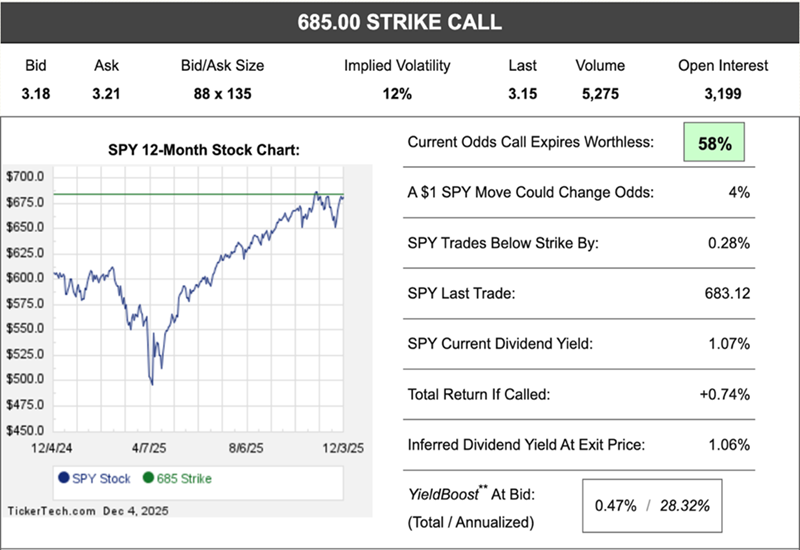
- The odds that the call will expire worthless—which is important if I prefer to keep this position. OptionSignals is telling me it’s a coin flip—58%—that these shares will be called away from me.
- If they are called away, then I will enjoy a 0.74% total return. (When writing above the current price, we keep the upside up to the “strike price” of the option—which is $685 in this case.)
- The “YieldBoost”—our enhanced yield earned by selling the option (remember, when we sell it, we get the cash right then, no matter what happens!)—is a seemingly modest 0.47%, but wait! That actually annualizes to a stupefying 28% thanks to the short timeframe. These short-term options lose value fast, which is ideal to us as sellers.
If my strong preference is to keep the SPY shares, then I’ll scan OptionSignals for higher strike prices. Here, when I move up to the $690 strike for SPY, I upgrade my chance of keeping the shares to 77%—and can write more calls for income again:

The “catch” is that my tradeoff is a lower YieldBoost—0.18%, or 11.2% annualized. No, it’s not 28%, but it is still much better than the microscopic 1.1% dividend yield provided by SPY!
When does OptionSignals flag SPY as a prime candidate for call writing?
- It identifies SPY in a medium-term uptrend, according to a volatility-based trading band system that I developed. My trend system filters out the signal from the noise to show us which direction (bull or bear) is likely to prevail in the coming months.
- Within this medium-term trend, when SPY is overbought on a short-term basis (again, according to my own system, but in a condensed timeframe), it’s likely due for a breather. Which makes it an ideal candidate for writing covered calls.
By writing calls on current positions we own as they pull back, we generate meaningful income that improves our total returns and buffers our downside. We need not sell SPY and “hope” that we know when to reenter the position. We can kick back and write calls, enjoying YieldBoosts up to 28%!
Let’s flip from SPY to technology stocks and the Nasdaq. In recent writeups, we’ve discussed covered call funds such as Nuveen Nasdaq 100 Dynamic Overwrite Fund (QQQX) and Global X NASDAQ 100 Covered Call ETF (QYLD), which offer yields up to 11.8% by employing the strategy I just described on the NASDAQ index itself.
But with OptionSignals, we have a DIY route to mimic these funds! We simply plug an Invesco QQQ Trust Series (QQQ) position into OptionSignals and we’ll again have more potential call-writing strategies. One short-term call option offers a 0.69% “YieldBoost,” annualizing to 42% (sound of your jaw dropping!):
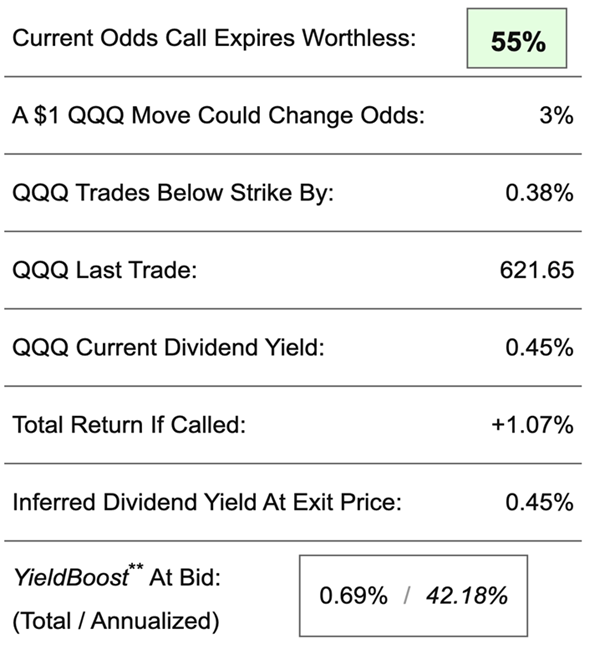
Think of this as the “homemade” version of QQQX and QYLD! Thanks to OptionSignals, this scratch-kitchen approach can be quite lucrative.
OptionSignals can also be applied to individual stock positions. Take Annaly Capital (NLY), a mortgage REIT that has rallied 5% since we recommended it a few weeks ago.
If you bought NLY, you’re up 5% on a stock that still yields 12.3%. The outlook for 2026 is bullish. Are you going to get cute and “sell high” on this dividend machine?
Of course not! It’s a much better idea to write covered calls on NLY! If it’s due for a breather, why not collect even more cash?
We have that suggestion from OptionSignals, including three potential trades to make:
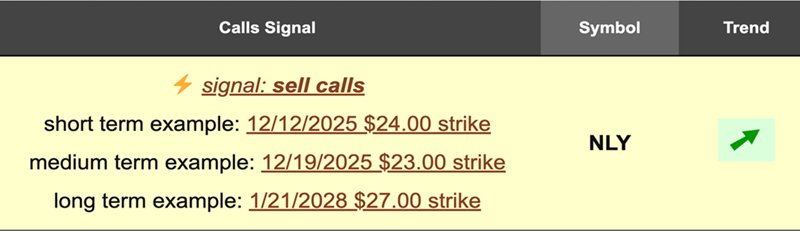
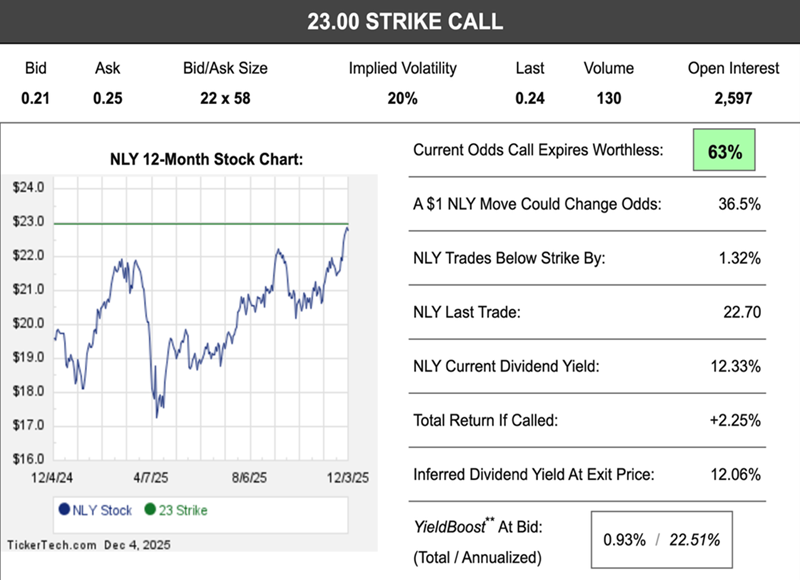
NLY trades around $22.70 as I write, and there are call options selling between $0.21 and $0.25 that expire on December 19 with a $23.00 strike. This is more than one-third of Annaly’s quarterly dividend!
When we sell these options, we receive a 0.9% YieldBoost, which annualizes to 22.5%. And remember, if NLY does rally above its strike price before our option expires, we get to keep a 2.25% total return (a crazy 22.5% annualized!):
Pretty sweet.
The challenge when writing calls and selling puts is always the timing. The temptation—and the top mistake new option writers make—is constantly selling options with no regard for price action probabilities.
We savvy contrarians write calls when shares are short-term toppy. This maximizes our income and helps cushion against downside.
Likewise, we sell puts when shares are bottoming. We are telling the market that if this stock gets any cheaper, we’ll take it at a discount—and in the meantime, we’ll pocket the put premium for income (thank you very much!).
If you’re not yet an OptionSignals subscriber, please activate your risk-free trial here. Now, let’s get into some FAQs from fellow users.
Q: How does the trend (up or down) signal work?
This is a medium-term signal based on a unique formula I created to filter the noise from short-term price movements. If a stock is down this week but my signal says the trend in OptionSignals is still up, we know to ignore the recent price action as unimportant—mere “noise.”
My inputs are always different from those traditionally used on Wall Street. I don’t use vanilla metrics like moving averages because everybody else is already looking at them. My trends don’t pay attention to traditional technical analysis, and trust me it’s a very good thing to be unique.
Q: Why did the system suggest writing a covered call for a stock in a downtrend?
Annaly (above) is a classic example. It has rallied since my initial recommendation. It’s likely to pause here or dip before it keeps running.
So why sit through the pullback when we can sell calls and bank more cash?
Q: Must I pick one of the three option ideas provided by OptionSignals?
No! The tool is merely that—a tool that signals promising setups. You are your own options chef. Please pick the trade that is most appropriate for your income needs! OptionSignals is here to provide you with all of the information you need to make the optimal decision for yourself—including “call away” odds, current option prices and (of course) YieldBoosts.
Q: How do I create a new OptionSignals portfolio?
If you are an Income Calendar subscriber, you’ll have your IC portfolios available in OptionSignals (<Brett jumping up and down!>).
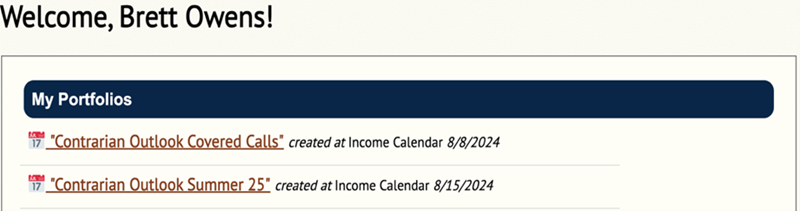
To create a new portfolio, you can scroll down beneath the current portfolios and click the link to create one. You can also sync between OptionSignals and your online brokerage.
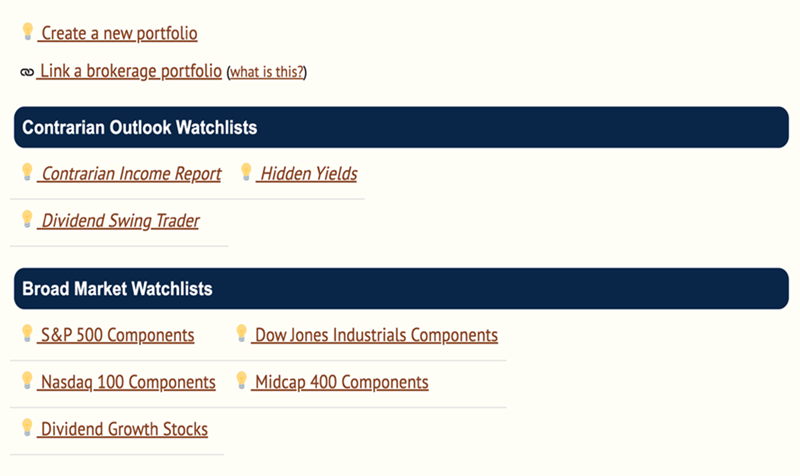
Here, you can also access current Contrarian Outlook watchlists as well as components from key market indices.
Action to Take: Boost your investment income with Option Signals—activate your risk-free trial here.
Recent Comments