
The Iran conflict has, of course, sent oil prices spiking. And the tensions in the region are unlikely to end soon.
Wherever you stand on the conflict, let’s set that aside for a moment and look at the situation through an investment lens—specifically what it means for those invested in oil, either directly or through shares of producers.
It’s clear that anyone holding oil and oil-related stocks saw a bump in their share prices after hostilities broke out, and prices have bounced higher and lower since.
Let’s look at exactly what’s played out so far this year (as of this writing) from the oil-price side—through the crude-tracking United States Oil Fund (USO)—and the producer side, through the Energy Select Sector SPDR Fund (XLE). XLE holds big US oil majors like ExxonMobil (XOM) and Chevron (CVX).
Oil ETFs Surge
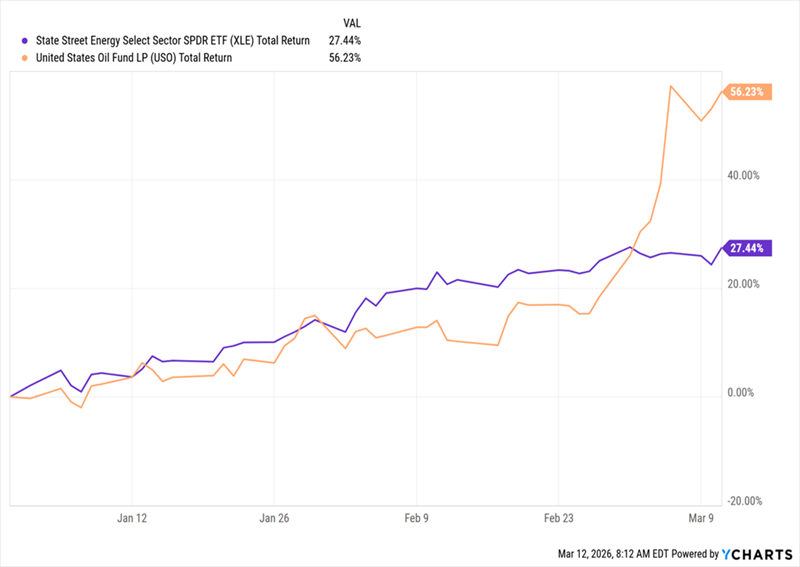
It’s just another example of oil’s ability to deliver big short-term gains on geopolitical worries. But the real risk with oil is that, while it can deliver strong gains in the short run, in the long run, it has historically lagged stocks. It’s been far more volatile, too.
In other words, to really make money in oil, you need precise timing—on both your buys and sells. (And it doesn’t hurt to have nerves of steel, either!) To see what I mean, let’s look at the performance of the above two oil ETFs in comparison to the benchmark SPDR S&P 500 ETF Trust (SPY), in blue below:
Oil Tends to Lose Over the Long Haul
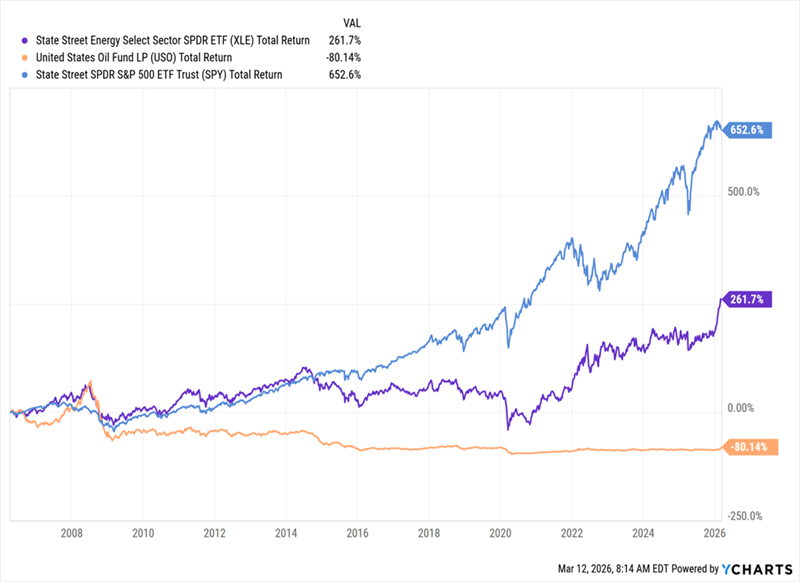
If we go back as long as all of these funds have been around (in the mid-2000s), we see that buying an index fund has been far more profitable than investing in oil funds.
It just goes to show that in investing (particularly in more volatile areas like oil), one of the biggest risks isn’t choosing the wrong stocks. You can also go wrong by choosing the right stocks, but doing so at the wrong time.
When I first started working on Wall Street in the early 2010s, many of my bosses, co-workers and clients would repeat the adage that “Being too far ahead of your time is indistinguishable from being wrong.” This phrase comes from legendary value investor Howard Marks, of Oaktree Capital Management.
That piece of wisdom shows up clearly with oil. Even over the last 10 years, investing in crude (again, either directly or through producers) would have been a much less profitable move than simply buying an S&P 500 index fund, as you can see below.
Even “Shorter-Term” Oil Investments Underperform
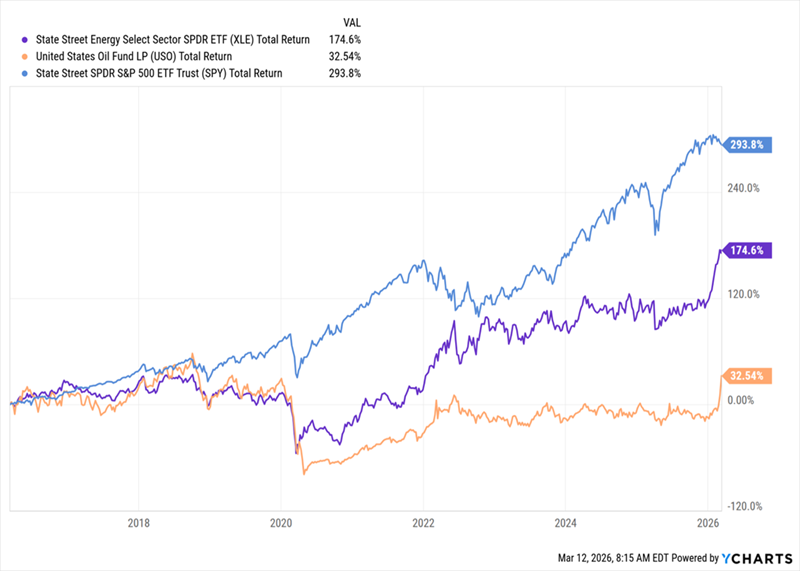
This is why we avoid oil funds in my CEF Insider service. We’re in it for the longer term and the dividends—and energy-focused funds just don’t support those goals.
When it comes down to it, a portfolio holding a diversified collection of CEFs holding stocks, bonds, real estate investment trusts (REITs) and other asset classes is a much better proposition. What’s more, we don’t need to “time” our entrances and exits as cleanly as resource investors must, so our approach is a lot less work, too!
By the way, that focus on dividends is why we look to CEFs, not ETFs. SPY, after all, yields just 1.1% as I write this. That means we’re relying on capital gains to get the cash we need. And to take those profits, we’re going to have to sell our SPY shares. This, of course, raises the risk of being forced to do so in a downturn.
This is where closed-end funds (CEFs) come in. Take a look at the performance of a CEF called the Adams Diversified Equity Fund (ADX), in orange below. Over the last decade, this equity-focused CEF (current yield: 8.2%) has posted a total return ahead of SPY (and by extension our two oil ETFs, too):
ADX Outruns Stocks, Yields 8.2%
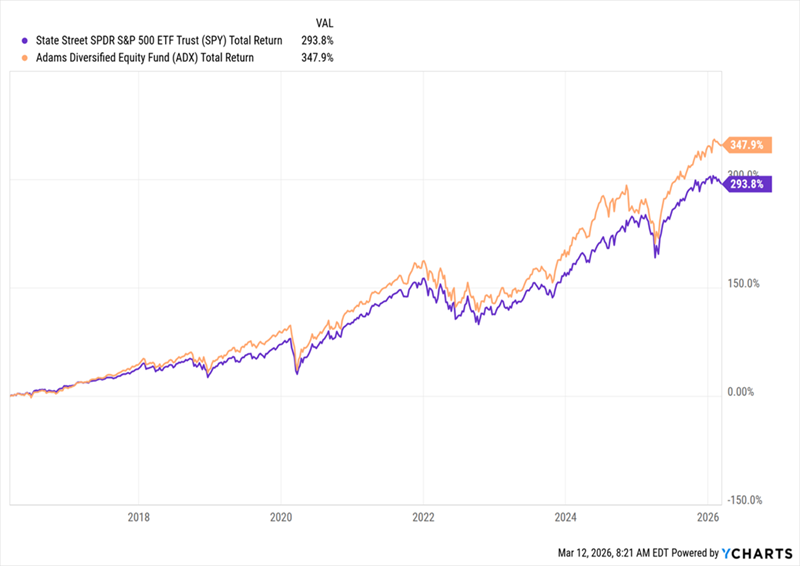
The nice thing about ADX is that it mainly holds S&P 500 mainstays like NVIDIA (NVDA), Apple (AAPL) and Microsoft (MSFT). Those, in fact, are the top-three positions for both SPY and ADX at the moment. Yet ADX has still outrun the index fund over the last decade (and most other long-term time horizons, I should add).
And thanks to its 8.2% yield, the income stream you get from ADX is more than seven times greater than what you’d collect from SPY.
Now, we do need to bear in mind that ADX’s dividend is tied to the performance of its underlying net asset value (or NAV), so it can fluctuate somewhat. But the fund still targets an 8% payout, based on NAV, so we can still expect an income stream far larger than that of SPY here.
One other thing to note is that the fund has seen its discount to NAV narrow lately, to around 4%, putting it right around my buy-up-to price. So while it may not be a top destination for new money now, it’s worth picking up on a dip. Members of my CEF Insider advisory get up-to-the-minute advice on when the best time to add ADX will be.
But our key takeaway is clear: Funds like ADX are a far better alternative than SPY, giving you much higher dividends while keeping your exposure to many of the same US large caps. Oil stocks? Their performance isn’t even close—and they’re likely to give you way more risk (and stress), too.
Get My Latest Call on ADX, and My Top 5 Monthly Dividend CEFs, Right Here
Like I said, the best way to know exactly when to snag ADX at the best price (and the highest yield) is to take out a subscription to CEF Insider.
And you’re in luck: Right now, I’m offering a 60-day “road test” of the service with no obligation whatsoever.
That’s not all.
I’ve also put together a portfolio of monthly dividend CEFs that pay you steadily, month in and month out. These 5 funds—my top 5 picks among monthly payers—yield a rich 9.3%, too. They’re the perfect complement to the more-growth-focused ADX.
Here’s how to take advantage of this unique wealth- (and income-) building offer:
Recent Comments