
Can income investors get in on the coming SpaceX IPO before the stock goes public (and ideally without overpaying?) Let’s find out.
No announcement of an IPO has been made, but SpaceX’s recent acquisition of Starlink and Musk’s xAI firm signal that an offering is in the pipeline.
Even though the company still feels relatively new, SpaceX successfully launched its first rocket 18 years ago. Since then, it has reportedly earned roughly $20 billion in government contracts, with Morningstar recently reporting that it posted about $8 billion of profits on $15 billion of revenue in 2025.
If those numbers stand up—and there’s no way for us to confirm them—that’s a profit margin above 50%. The company’s success with Starlink will likely help keep its margins high.
Which brings us back to the question I just asked: Can we get in, say, now, before the stock trades publicly? The answer is yes, there are a couple of routes.
Both run through funds—either an ETF or a closed-end fund (CEF)—with exposure to the company. Here are two options, with a third (my preferred choice) at the end.
Option 1: The ETF Play
The ERShares Private-Public Crossover ETF (XOVR) holds SpaceX indirectly, through a “special purpose vehicle”—a type of private fund focused on private securities.
XOVR then balances its SpaceX exposure with public tech firms like NVIDIA (NVDA), Meta Platforms (META) and Palantir Technologies (PLTR). There’s also a dash of healthcare in its top-10 holdings, with medical-device maker ResMed (RMD), and finance, in the form of Interactive Brokers Group (IBKR), a trading-services firm.
That seems like a pretty good mix from a risk-management perspective, right? Unfortunately, it has still led to a pretty rough long-term performance:
XOVR Lags the Tech Sector and the NASDAQ
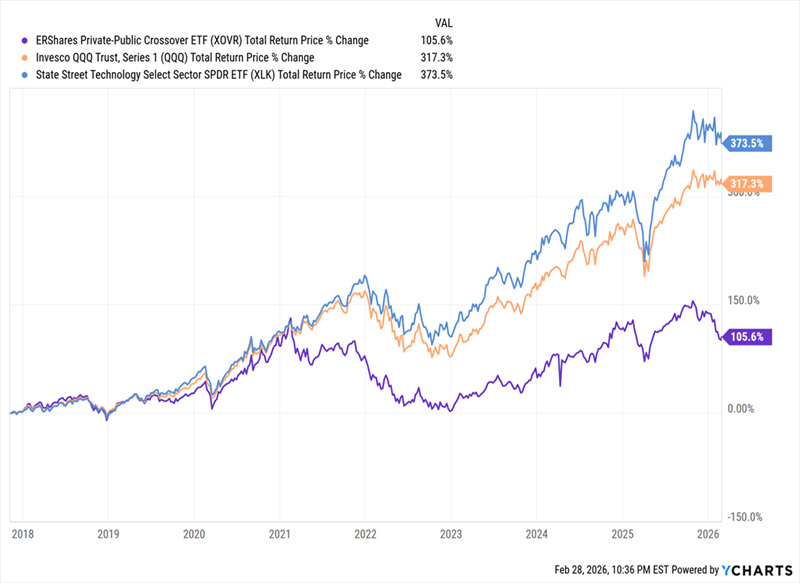
As you can see above, since the inception of XOVR (in purple), the fund has returned less than a third of the return of the State Street Technology Select Sector SPDR ETF (XLK), in blue and a good benchmark for the tech sector as a whole. XOVR was nowhere near the NASDAQ-focused Invesco QQQ Trust (QQQ), in orange, either.
Could the SpaceX IPO reverse this performance? Truthfully, probably not.
A bigger concern for XOVR is that, in a nutshell, regulations require that the fund have no more than 15% of its assets in one private company, and its SpaceX exposure is now 37% of its portfolio, according to the fund’s website.
That, as the Financial Times recently wrote, is a risk for XOVR investors, as the fund could be forced to sell the shares to comply with that rule, and the timing of that sale could cut off any profits from the IPO.
Option 2: The CEF Approach
CEFs are structured differently than ETFs, and importantly no longer have the 15% requirement ETFs do, when it comes to investing in private firms. CEFs carry another benefit, too: They pay high dividends, with the average yield sitting at 9.3% across the space, according to data tracked by my CEF Insider service.
Only one CEF has a significant slice of its portfolio devoted to SpaceX: a fund called the Destiny Tech100 (DXYZ). One thing leaps out about this one: Even though it’s a CEF, it doesn’t pay a dividend. Its performance in the past year hasn’t been promising, either, down about 24%:
SpaceX Can’t Stop DXYZ’s Tailspin
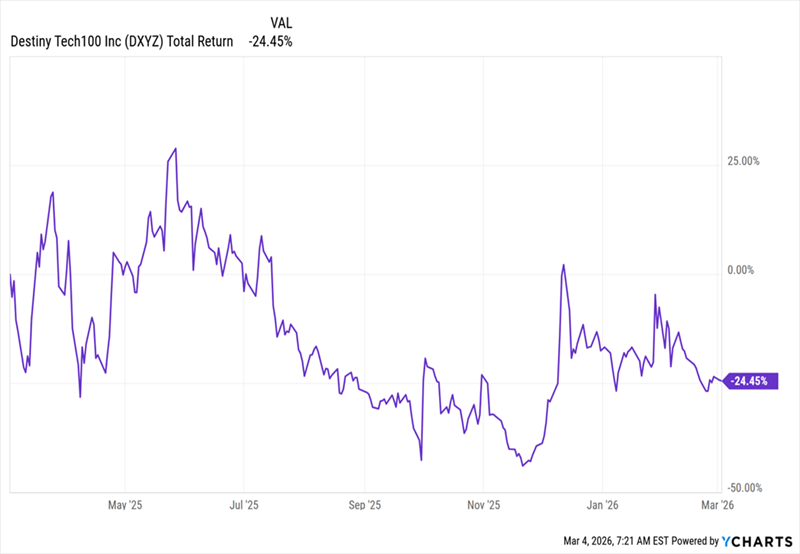
Meanwhile, the NASDAQ is up about 22% and XLK, the tech-benchmark ETF we talked about a second ago, has gained 27%.
We’ve been watching this fund for about a year. I wrote in a February 27, 2025, article that:
“With DXYZ’s huge markup, we’re overpaying to speculate on the future, especially if earthly economic woes replace moonshot optimism among the technorati in the next few months. There’s just no reason to take that risk.”
The “earthly economic woes” are a mix of fears around what AI means for the economy, fears that DXYZ’s holdings aren’t worth a premium (especially in light of its 0% yield), and fears that DXYZ won’t capture the economic value of a SpaceX IPO.
And even with that 24% drop in its total return, the fund still trades at a 41% premium to net asset value (NAV, or the value of its underlying portfolio). That’s a lot even for a solidly performing CEF. For one with hard-to-value private assets, it leaves very little margin for error.
So where does this leave us?
Our Best Play: NASDAQ Exposure With an 8.9% Payout
At this point, getting exposure to SpaceX pre-IPO is a tall order for regular investors like us. However, one way to get diversified exposure post-IPO could be the Nuveen NASDAQ 100 Dynamic Overwrite Fund (QQQX).
It’s an 8.9%-payer that, like its cousin QQQ, holds the stocks in the NASDAQ, which SpaceX will likely join. Tesla (TSLA) is already listed here.
The difference between QQQX and QQQ is that the former sells covered-call options on its portfolio, a smart strategy designed to generate income. (Using covered calls, QQQX sells rights to investors to buy its holdings at a fixed price and date in the future—this approach is more profitable in volatile times.)
That’s helped QQQX outperform QQQ over the last six months—which included AI-driven panics around software and IT stocks—while delivering that high payout (QQQ yields just 0.5%). The fund has also fallen less sharply than QQQ since the outbreak of the war in Iran.
QQQX Outperformed Amid Recent Uncertainty
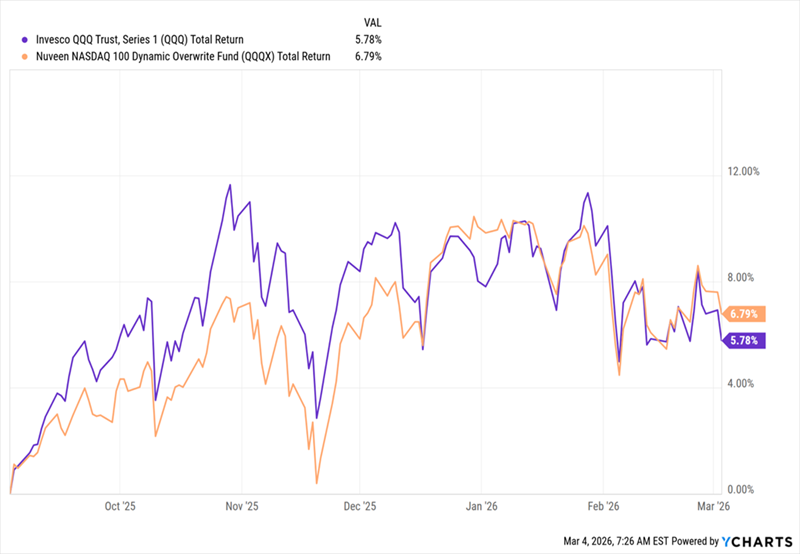
We do, however, have to bear in mind that the option strategy does cap upside in a strong market, as the fund’s best stocks are sold away. However, the fact that QQQX trades at an 8.9% discount to NAV, lower than the 7.8% at which it started the year, adds upside—and some downside insulation, too.
Overall, high-yielding QQQX is a better approach to tech than trying to chase pre-IPO companies like SpaceX. And it still puts us in position to get exposure to that high-margin firm when its shares hit the public markets, too.
5 More CEFs With Huge (9.3%) Dividends—and Discounts Set to Vanish
The deal on QQQX is available in part because CEF investors are a small group, and they’re conservative, so they tend to move more slowly than other investors.
That makes CEFs one of the few places where the “little guy” is on a level playing field with the big players. And it’s an edge we never hesitate to take advantage of.
The widening discount on QQQX is an example of this advantage in action. But it’s far from the only one. My team and I have pinpointed 5 other “hidden” CEF bargains kicking out huge dividends—I’m talking about a 9.3% average payout here.
These 5 funds—which combined hold a wide range of stocks, bonds, REITs and other go-to income plays—also sport unusual discounts to NAV right now. That nicely positions us for upside to go along with our 9.3% payouts.
These funds’ next upward move could come gradually or all at once. That’s why we need to make our move now.
Recent Comments