
Today I want to get into a question that comes up on the regular in 8%+ yielding CEFs:
What if you run across two of these income generators that seem to be equal in pretty well every way. Can you just buy one or the other?
Truth is, sometimes you can and sometimes you can’t, but it’s not always clear when simply closing your eyes and picking one fund is the right move. That’s because with CEFs, there are a lot of moving parts one needs to pick apart and look at carefully.
Let me show you what I mean with two CEFs holding real estate investment trusts (REITs)—publicly traded “landlords” holding properties ranging from senior-care facilities to malls and warehouses. The beauty of REITs is that they’re “pass through” investments, sending almost all of the rent they collect to shareholders as dividends.
And we can get even higher dividends from our REITs when we hold them through CEFs, thanks to these funds’ active management and use of tools like a modest amount of leverage.
Which brings us to the two funds in question: the 8.1%-yielding Cohen & Steers Quality Income Realty Fund (RQI) and the 8.3%-yielding Cohen and Steers Total Return Realty Fund (RFI).
These two funds are, as the names say, both run by the same sponsor, Cohen & Steers, a company with deep roots in the CEF business, so we can count on a similar management style here.
Now, just looking at the headline yields, you might be tempted to just buy RFI and call it a day to squeeze that extra 0.2% in yield. But by the time you read this, it’s possible that both funds will yield exactly the same (this happens quite a bit with them). So we need a guide to pick between these funds that’s a bit more enduring.
Both funds have kept their payouts pretty much static for the last nine years (with the occasional special dividend dropped in for good measure), so that doesn’t help much.
The funds both have senior-care REIT Welltower (WELL), cell-tower owner American Tower (AMT) and data-center REIT Digital Realty Trust (DLR) as their top-three positions. And the rest of their top-10 positions are nearly identical, too, including the likes of warehouse REIT Prologis (PLD), self-storage REIT ExtraSpace Storage (EXR) and data-center play Equinix (EQIX).
So, with similar holdings, it’s tough to look at the portfolio and say one is definitely better than the other. The performance story doesn’t tell us much, either.
Great Returns Between Them
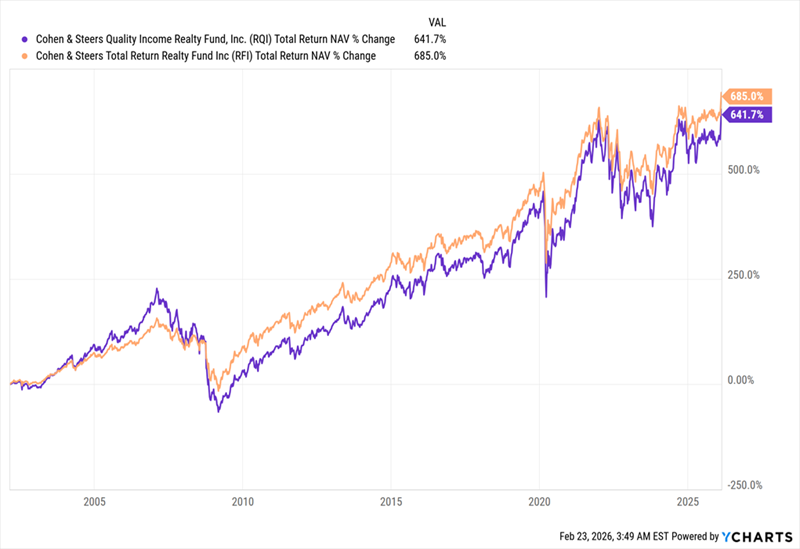
Both funds go back about 24 years, and over that time, both have delivered a total NAV return (that is, the return based on their underlying portfolios, not their prices on the open market) of 8.8% on average per year. That’s above both funds’ current payouts (meaning those payouts are sustainable) and too close to each other for either to be “better” on its own.
Now let’s talk discounts to net asset value (NAV, or the underlying value of their portfolios)—the key metric for whether these funds are “cheap” or “expensive.”
As I write this, RQI (in purple below) trades just below par, with a 0.9% discount to NAV, while RFI (in orange) is just above, at a 1% premium. Here too, the differences aren’t big enough for this to be, on its own, a deciding factor. Yet again, we are stuck.
But wait a second. Let’s zoom in a bit.
A Clear Trend Emerges
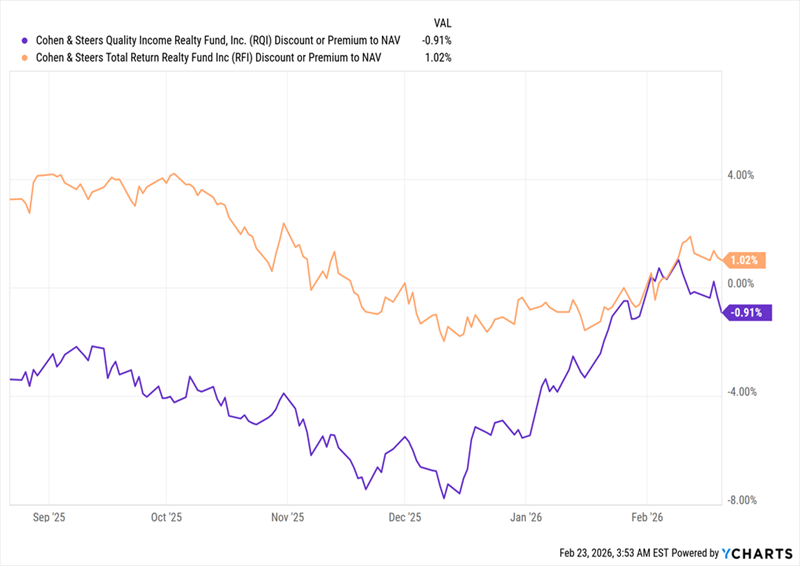
Notice how RFI’s 1% premium is a bit lower than where it was six months ago, while RQI’s discount was much larger at the end of last year?
This means you can buy RFI at its current premium and hold till that premium rises back toward where it was six months back. I see a gain in the premium as likely, as interest rates are likely to be cut further in the months ahead (though we’re not exactly sure when), lowering REITs’ borrowing costs. That’s critical for these funds, as they borrow heavily to finance their properties.
RFI’s Closing Discount Can Deliver Big Gains—Like It Did in ’19
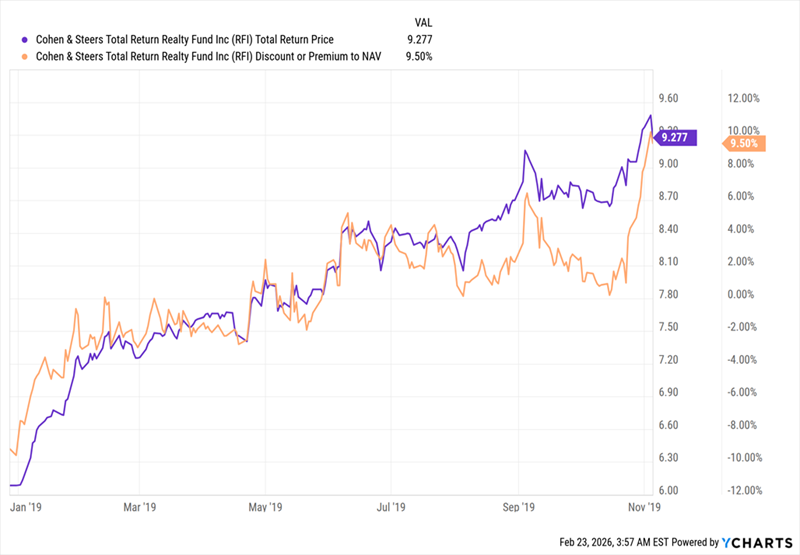
This isn’t the first time RFI has given investors such an opportunity. It happens a lot, actually. For instance, look at the chart above, when RFI’s discount (in orange) cratered in late 2018. It then surged to a 9% premium, giving investors a 52% return in a year.
While it’s unlikely that RFI is going to deliver another 50% return in a year, big returns like this are overdue for REITs. But if the next big rise takes time to show up, that’s fine. This 8.1%-yielder (as I write this) is an income giant likely to keep its payouts high. Some special dividends are also on the table here, just like they have been in the past.
All of this gives RFI an edge over RQI right now. You’re getting nearly identical assets, along with upside, since the fund is more undervalued relative to its history and to RQI right now.
My 5 Top Monthly Dividend CEFs Pay Out 60 Times a Year (and Yield 9.3%, Too)
It’s clear that RFI, with its “discount-in-disguise,” is a smart pickup now.
But it’s not the only fund I’m pounding the table on. Fact is, I’ve assembled 5 other CEFs that pay even more on average—I’m talking about a rich 9.3% dividend—and pay dividends monthly, as well.
Think about that for a moment: With these 5 funds, you’re getting paid around 5 times a month. That’s a total of 60 dividend payouts a year!
I’ve put all 5 of these reliable monthly payers together in a “mini-portfolio” all their own. I’m urging all investors to take a close look at it now.
Oh, and there’s more for us here than “just” that 9.3% average payout. These funds also trade at unusual discounts, putting strong upside on the table, too.
Now is the time to buy them and start your 60 “paycheck” income stream. Click here and I’ll tell you more about these 5 stout monthly income plays. I’ll also give you a free report revealing their names, tickers and my full analysis of each one.
Recent Comments