
I took a glance around the gym from my courtside seat on the baseline.
Yup, I was definitely the only person in attendance without a kid playing in the game. My face was the giveaway. I wasn’t emotionally invested. I was detached. Analytical. Calculating.
I was a scout.
That’s right, your investment strategist—who coached the previous game—waved farewell “for a few minutes” to his wife and kids in the parking lot to watch the “beginning” of the next contest.
Forty minutes later, I was excitedly texting my assistant coaches with my findings. No reply, however, because they were likely having dinner with their families like normal people. Fine.
I had figured out the first part of the puzzle. Our crosstown rival, playing in front of me, would defend us next week using a “1-2-2 zone.” They always play a 1-2-2. I knew that. But I wanted to make sure they started the second half in it.
They did. But instead of leaving, I racked my brain to solve the second riddle. What offense should we run against this defense? We had only two practices left, not enough time to install an entirely new system. In fact, a design too alien would ask a lot of my players.
Oh, the decisions a coach must make in-season. (This is a fifth and sixth grade league, for those of you wondering how serious my side hustle is. It is, clearly, a life-or-death matter.)
I haven’t seen a 1-2-2 since the late 1990s. Maybe the mid 90s? It’s effective but only up to a certain age group. We were still in that “target market.” So, how’d we break this thing 30 years ago?
No idea. If I had an active cell number for my youth league coach Mr. Sweeney I would have asked for advice. (“Hey, it’s Brett Owens, we last spoke when I was 12…”) I didn’t, so I dialed up the next best thing—Gemini.
Hey Gemini, what is the optimal offensive set for a 5th and 6th grade basketball team playing against a 1-2-2 zone? Pass-heavy solutions are preferred (less dribbling). Also, we have 3 beginner players so please favor offenses that are easy to implement.
From there, Gemini solved the puzzle. The 1-3-1 offense!
It was “close enough” to the positions our players naturally gravitate to. And it attacked the weakness I was looking to exploit: the wide open “middle” near the free throw line. My daughter will play there because (like her old man) she knows the high post.
Perfect. I sent another too-long text to our coaching staff with my findings.
Would I have found the solution without AI? Yeah, eventually. Deep in my reptilian basketball brain I remembered that you attack a zone with an “odd man” front somewhere (hence our 3 versus 2 at the second level). Except…haven’t thought about that in three decades.
AI to the rescue, though, saving me a couple of hours of internet research. I walked in the door a few minutes after 6pm, got a quick update on what I missed (stopped at McDonald’s so the youngest could use the potty) and explained my “high post” findings to my oldest.
A short sidetrack. Here’s the thing. If a rec league basketball dad is game planning with AI, what do you think actual businesses are doing with it? This is the story that vanilla investors are completely missing. They’re debating whether NVIDIA (NVDA) at 30-something-times sales is a buy or a bubble. Wrong question!
The right question is: what happens to prices when every business on the planet “hires” a tireless, dirt-cheap digital employee?
The answer is lower costs. Which means lower inflation, which means lower interest rates. This is why our bond-friendly dividend plays are cookin’ beautifully right now.
And my favorite is really sizzling. Last August, right here in these contrarian pages, I pointed you to the iShares 20+ Year Treasury Bond BuyWrite Strategy (TLTW) and its 12.2% monthly dividend:
Next time you see suits on TV hyperventilating about bonds, just sit back and smile. Their persistent worries only pump up TLTW’s premium income!
Readers who bought have banked 8% total returns already, including those fat monthly payouts. Not bad for “boring” Treasuries! If you invested $100,000, you’re sitting on about $8,000 gains in under six months!
My thesis was that Treasury Secretary Scott Bessent would cap long-term rates. Scott did exactly that by quietly funneling 80% of new debt issuance to the short end of the curve. This limited the supply of long-dated Treasuries. With a supply-demand imbalance, prices rallied and yields fell.
TLTW is a bit hot now, rallying past my buy range over in Dividend Swing Trader (where it’s an official holding with 10.2% current gains). We contrarians don’t chase. For now, we turn our attention from bonds to bond proxies.
If falling rates are the trend, the utilities with growing dividends will rally too. Which brings us to one of the most important monopolies in America. American Water Works (AWK) is the largest publicly traded water and wastewater utility in the country. Its business model is built around a rusty reality: America’s pipes are old, and someone must fix them.
AWK is planning to invest $46 to $48 billion over the next decade on infrastructure replacement. This spending powers profits through the “virtuous cycle” that makes regulated utilities so reliable: build infrastructure, add it to the rate base, collect guaranteed returns from regulators, repeat.
AWK has hiked its dividend for 17 consecutive years. Seventeen! Yet the stock languishes 25% below its late 2021 highs. Our dividend magnet students know how this story ends. Over time, rising payouts drag their stock prices higher, “magnets” that pull shares up to match the growing income stream.
AWK’s Dividend Magnet is Due
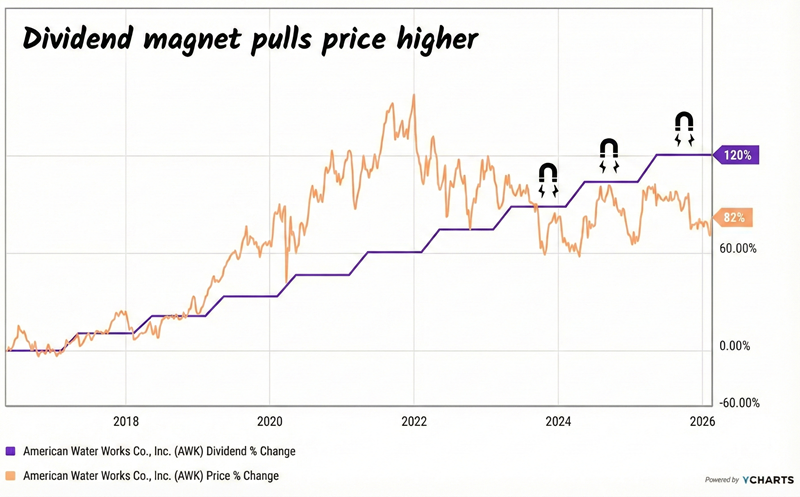
A few bears are throwing in the towel. Bank of America just upgraded AWK, slashing their “Underperform” rating and hiking the price target by nearly 20%. Other bears are hibernating. Only two of 10 analysts covering AWK have a “Buy” rating or better.
Two of ten! Which is perfect because stocks loathed by analysts are strong candidates for upgrades. Each upgrade sends the price a little higher, and one day you wake up to a stock that’s popped 5% overnight because some suit finally did their homework (or asked Gemini—ha!).
There’s more bear capitulation to come. We’ll be collecting AWK’s safe 2.6% yield while we wait for the upgrades to hit the tape.
In basketball and income investing, the simplest play (or payout!) is the one to make. No, we don’t need a complicated AI trade to profit from the AI revolution. We just need a boring monopoly with a growing dividend and a price that hasn’t caught up yet. That’s AWK.
PS: We picked up a bonus game Sunday and won 30-28 after trailing by 8 points early. This gives us momentum heading into this week’s test when we run Gemini’s 1-3-1 against the crosstown rivals. Stay tuned.
The dividend magnet strategy behind AWK has already delivered some of our biggest winners in Hidden Yields: 148% on Texas Instruments, 83% on TD Synnex, and a quick 27% on American Electric Power—all powered by rising payouts pulling stock prices higher.
Right now, I’ve got 5 new dividend magnets in my crosshairs. Their dividends have been climbing for years, but their stock prices haven’t caught up yet. That gap is our opportunity.
I’m putting the finishing touches on the February issue of Hidden Yields this week. If you want in on these 5 picks before the next round of analyst upgrades hits and access to my brand-new dividend growth pick this Friday, you’ll want to subscribe right now.
Click here to try Hidden Yields risk-free and get my 5 Dividend Magnet picks today.
Recent Comments