
If you’re wondering whether the rally in tech stocks is fading, well, it is.
So if your portfolio is heavily weighted toward the sector (and it very well could be, given tech’s meteoric run), it’s time to shift.
We’re going to look at why the so-called Magnificent 7’s years-long run is set to ease in the months ahead. Then we’re going to go on offense and defense at the same time.
On offense, we’ll look to front-run the crowd into what I see as the next hot sector to benefit from the rise of AI. And for defense, we’re going to make a move to boost our dividend income substantially.
That way we’re not only building our income stream but we’re hedging against volatility, as we’ll be getting more of our return in cash.
Let’s start with why I see tech fading this year, after more than three years of dominance. But do keep in mind I’m not advocating selling out of tech—there are still lots of gains to come as it embeds itself further into our lives.
What I am saying is that it’s time to rebalance so we have free cash to put toward the strategy we’re going to get into today. The good news is that you can get a large part of the way there with just one buy—and no, it’s not an ETF. We’re going to get a level of income that’s very difficult to get with ETFs alone.
The Magnificent 7 Pass the Baton
The big-cap tech darlings have been called a lot of things over the last few years. Remember FAANG? It was an admittedly weird acronym consisting of Meta Platforms (META), then called Facebook, as well as Amazon.com (AMZN), Apple (AAPL), Netflix (NFLX) and Alphabet (GOOGL), then, of course, called Google.
All the corporate name changing—and the fact that Netflix essentially became a movie studio—put an end to FAANG. So we moved to the Magnificent 7: Apple, Amazon, Alphabet and Meta, as well as Microsoft (MSFT), NVIDIA (NVDA) and Tesla (TSLA).
These stocks demolished the market back in 2023 and 2024, as more investors realized AI was going to be a major turning point for the economy and society as a whole.
This encouraged some fund managers to start ETFs that invest only in the Mag 7, like the Roundhill Magnificent Seven ETF (MAGS). It also spurred funds that trade in everything but, like the Defiance Large Cap Ex-Mag 7 ETF (XMAG), whose portfolio, as the name suggests, holds the S&P 500 minus the Mag 7.
When we compare these two, we start to see the tech “fade” I mentioned earlier.
Mag 7 Slows, Rest of the Market Gains
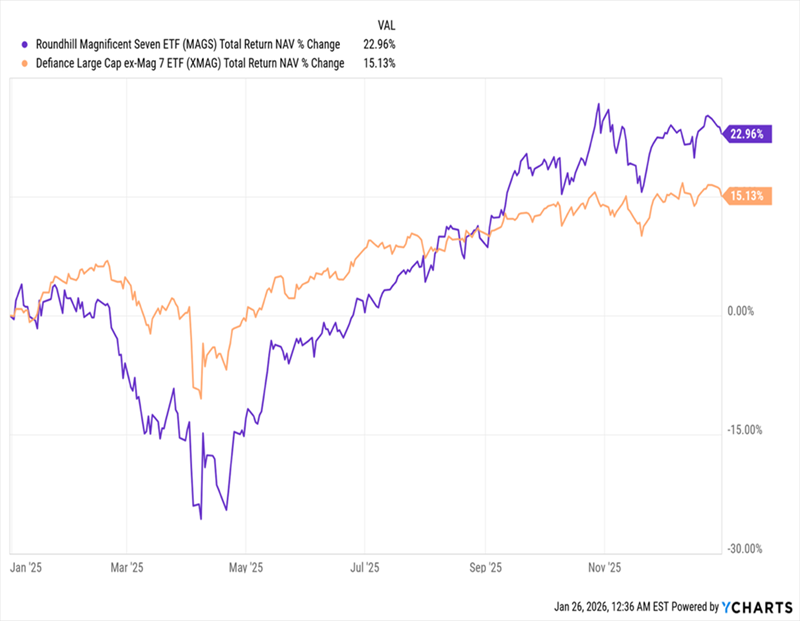
This chart compares these two ETFs’ performance in 2025. As you can see, XMAG (in orange) actually led the Mag 7 ETF (in purple) for much of the year, and only trailed by seven points at year-end.
This pattern is the result of a well-worn business cycle. It goes like this: One company (or sector, in this case) develops a new, more efficient way of doing something (AI). Then they start using it, making more money as a result.
Others in that sector copy the method. Then firms in other sectors realize this new approach can be adjusted for their use, so they adopt it and grow more efficient.
The name for this is, I kid you not, GPT, “general purpose technology.” It describes when an innovation in one field can be generalized to others. It’s a supreme irony that ChatGPT and other AI tools are themselves a kind of GPT!
This is happening slowly and unevenly, but it is one reason why the rest of the market is catching up to the Mag 7. And there’s still time for us to front-run this shift, which is apparent in more than just tech firms’ stock performance. Take a look at this:
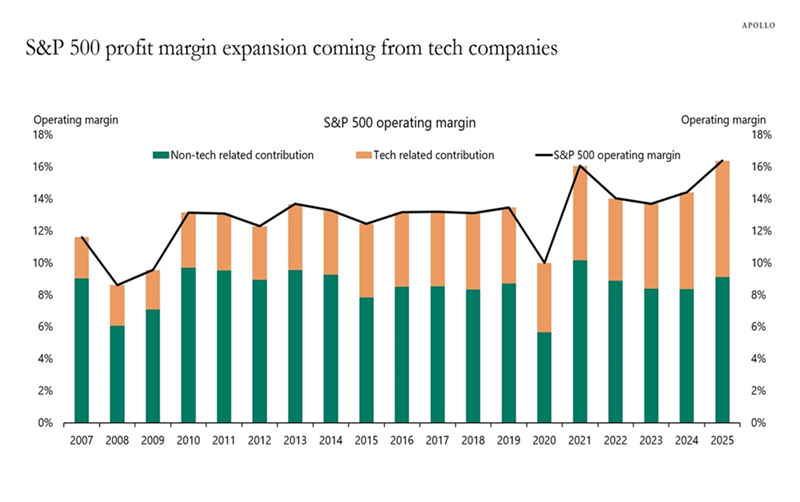
In this chart from Apollo Global Management chief economist Torsten Sløk, we can see how operating margins for the tech sector (in orange) have expanded, compared to the broader S&P 500 (in green). We also see that overall, the operating margin of the S&P 500 (including tech) rose from around 12% in 2007 to about 16% in 2025.
In other words, publicly traded companies grew about a third more efficient over this period. But note that all of this gain came from the tech industry.
But now we’re starting to see the, er, GPT of ChatGPT and other AI tools spread into other areas. That means we need to look beyond tech to put our strategy in play.
An 11.6%-Paying Fund in the Next Sector to Win From AI
We can do that with one closed-end fund (CEF) we added to my CEF Insider service late last year: the abrdn Life Sciences Investors Fund (HQL), which yields 11.6%.
HQL has a range of tools to help it deliver that payout. For starters, it’s run by medical researchers (Jason Akus, head of Aberdeen’s healthcare investments, is a doctor). And they’ve built a portfolio of strong biopharma stocks, such as Amgen (AMGN), Regeneron Pharmaceuticals (REGN) and Gilead Sciences (GILD).
These firms are ripe for AI optimization. In fact, most of the sector is using the tech already, to improve research and slash drug-development timelines (and risks).
These were some of the reasons why I recommended HQL to subscribers of my CEF Insider service in October 2025. Since then, the fund’s net asset value (NAV, or its underlying portfolio—in blue below) has topped the go-to S&P 500 ETF (in purple), including dividends the fund has collected on its holdings.
HQL Outruns the Market
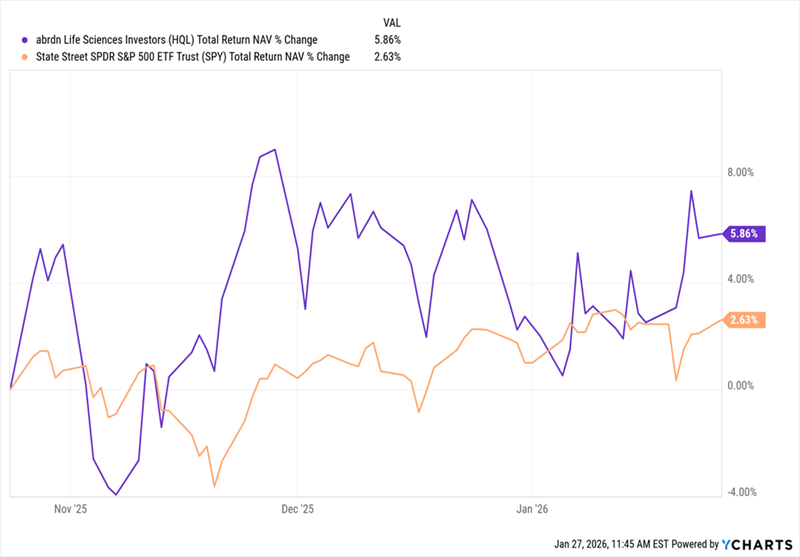
It’s not too late to get in: Even with this gain, HQL trades at a 9.6% discount to NAV as I write this. That’s around where it was at the time of my October recommendation, and it means we’re essentially buying for around 90 cents on the dollar.
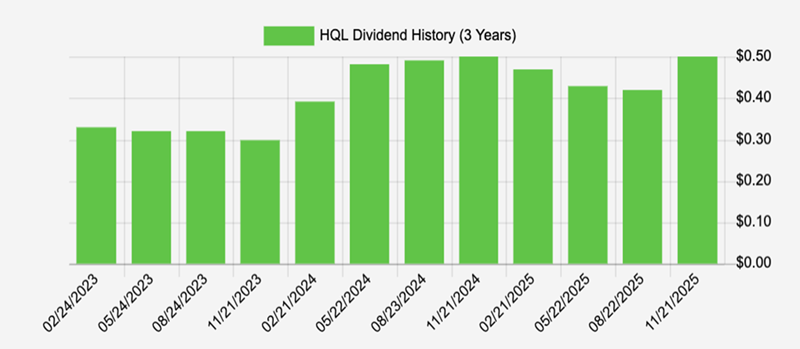
HQL has a “managed” payout, under which Akus and his team can shift the amount they pay in any given quarter. This is a feature, not a bug; even though it does mean HQL’s payout floats around a bit, it also means the fund can pull back payouts in a market rout in order to have extra cash to buy the resulting bargains.
And in a bull market, HQL can ramp up payouts. That’s something they’ve done with the latest payout, as you can see below, and I expect more increases as AI optimizes the pharma business:
HQL’s Floating Payout Is a Benefit-in-Disguise
Source: Income Calendar
That’s why HQL is still attractive to us. And it’s just one example of how we can use CEFs to front-run AI’s move into other parts of the economy.
Moreover, there are plenty of other high-yielding CEFs in different (but equally “AI-ripe”) sectors we can use to pull off the same thing. Making contrarian moves like these—at discounts and with high dividends—is the core of our approach at CEF Insider.
These 4 CEFs Are Primed for AI’s “Next Wave,” Yield Up to 8.7%
I’m going to go one step further and give you 4 of my other top CEFs for front-running the next sectors AI is primed to revolutionize.
These 4 funds—all top picks from my CEF Insider portfolio—are the perfect companions to HQL. They yield 8% on average, with the highest payer of the bunch throwing off an 8.7% payout.
These reliable income plays also give us access to stocks that aren’t only developing AI but using it to boost their businesses, too.
Manufacturers. Insurers. Healthcare firms. They’re all here.
And thanks to these funds’ discounts to NAV, we can buy the stocks they own for less than we could if we bought them on the open market. And we’ll do so while collecting high, steady dividend payouts along the way.
Click here and I’ll introduce you to each one and give you a copy of my free Special Report, “4 AI-Powered ‘Disrupter’ Dividends Paying 8%.” It gives you the names, tickers and key facts you need to decide whether they’re right for you.
Recent Comments